Originally published on LessWrong
on 8 October 2026.
Summary: Science has a long list of documented
failure modes, such as p-hacking, the File Drawer Problem, shallow peer
review, and ignored retractions. This post catalogs about 50 of them
with the evidence for each, then predicts how each will change once we
have full AI researchers. On our current course, most get worse. AI can
run many more experiments, so more statistically lucky results will pass
the significance filter. Many AI researchers will be copies of the same
model, so their methods, errors, and reviews will be correlated. AI
agents have a tendency to reward hack, so misconduct may occur at a
greater rate. A few failures should improve since AI makes tedious work
cheap: reading every citation, hunting for bugs, and working through
long checklists. Requiring replication before publication would filter
out much of the statistical noise, but it would still be susceptible to
poor experimental design and over-generalized conclusions. How well the
science ecosystem will function depends on how we prepare before the
volume of AI research arrives.
As we enter into a new era of research where the primary scientific
contributors are likely to be AI (I expect 2 years until this occurs,
given where we are now
and the trends in AI research
taste), it is worth looking back at failure modes identified in
science and predicting whether any of these issues will be amplified.
The rest of this post relies on this assumption that AI researchers will
soon replace humans in research, but even if you do not share this
assumption, it is worth considering what effect AI will have on the
science ecosystem with these failure modes in mind.
This post catalogs about 50 failure modes in science, the evidence
for each, what makes each category worse, and rough predictions on how
AI researchers will impact that failure mode. This does not include the
novel failure modes we should expect from AI researchers, and
only lightly touches on potential solutions. The primary focus here is
on the failure modes; a different post will discuss mitigations. I group
the failure modes into seven categories.
Science is filled with exaggerated effects and false positives,
mostly unintentionally. The essential issue is that experiments are
noisy, filtered by significance (p < 0.05), and the base rate of true
results is low in many fields.
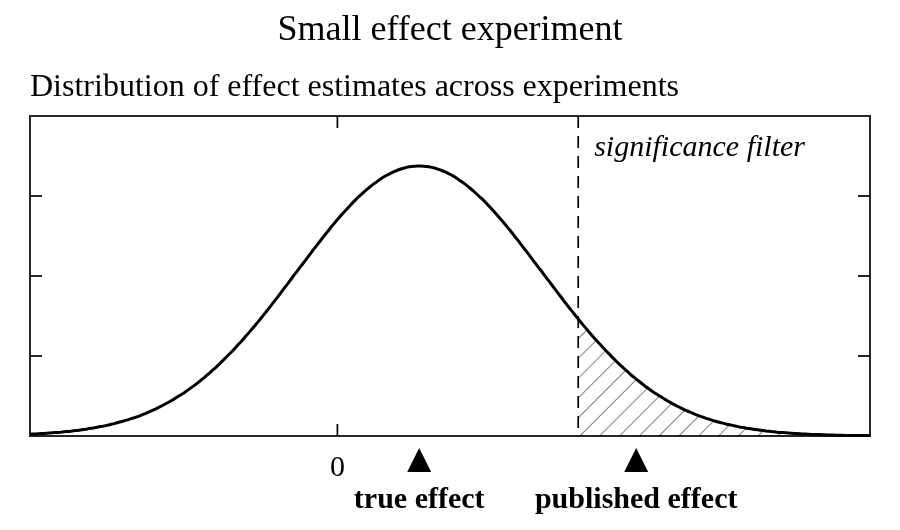
With noisy experiments and a filter, we only publish the lucky
results that made it past the filter, which inflates the estimated
effect of the result (sometimes called the Winner’s Curse), see “Why most discovered
true associations are inflated” Ioannidis (2008). This is concerning
since it will make effects look larger than they are.
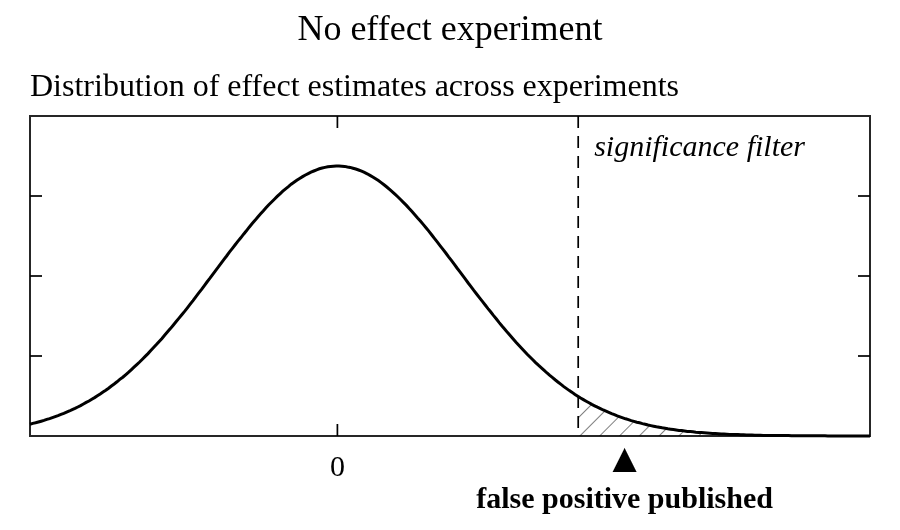
Worse than an exaggerated effect is a false positive. Even if a false
positive is unlikely, the chance that you have at least one will grow as
you run more experiments, and the average number of false positives will
increase with increased base rates of false hypotheses. “Why Most Published
Research Findings Are False” Ioannidis (2005) argued with a simple
model that with low power and low base rates most significant findings
in a field can be false.
There are many dimensions along which a significance filter causes
issues. The actions of a researcher are sometimes called p-hacking, but
note that each of these can happen unintentionally.
File Drawer Problem: Null results are not shared,
so the published results look like the only attempts made, rather than
the lucky subset of many.
Testing many hypotheses: Researchers test many
different hypotheses, publishing only the significant results. As an
extreme demonstration of this, “Neural correlates
of interspecies perspective taking in the post-mortem Atlantic Salmon:
an argument for multiple comparisons correction” Bennett et
al. (2009) scanned a dead salmon in an fMRI while showing it photos
of people, and found “significant” brain activity by testing thousands
of voxels (each voxel is essentially one hypothesis). This demonstrated
how it is possible to find significant results from null data if
researchers run enough tests and ignore the non-significant
results.
Many researchers: If multiple labs independently
run an experiment and one lab happens to get a significant result, only
the significant result is published. This is the File Drawer Problem at
the level of a field. “Publication bias in the
social sciences: Unlocking the file drawer” Franco et al. (2014)
tracked 221 peer-reviewed experimental designs and found that strong
results were 60 percentage points more likely to be written up and 40
percentage points more likely to be published compared to null
results.
Data dredging: Researchers may look through lots of
data until they find something significant. Brian Wansink’s Cornell food
lab publicly pushed students to mine null results until they could find
something significant, eventually leading to outside scrutiny,
retractions (Lee
2018, BuzzFeed News), and his resignation.
Garden of forking paths:“The
garden of forking paths” Gelman & Loken (2013) describes how
researchers make many choices during analysis, and each choice is
another chance for a result to become significant. This does not require
consciously trying multiple analyses. If the analysis that was chosen
depended on the data, the p-value is already wrong.
Subsets of data: Researchers check if there is a
significant result for a subset of their data. The ISIS-2
trial (1988) points out this error, warning in their analysis that
aspirin appears not to work for patients with the astrological signs
Gemini or Libra. This can be partially fixed by interaction tests, but
“Evaluation of
Evidence of Statistical Support and Corroboration of Subgroup Claims in
Randomized Clinical Trials” Wallach et al. (2017) found only 46 of
117 subgroup claims made in papers were backed by a significant
interaction test, and only 5 of those 46 were ever tested again, none of
which replicated.
Selective reporting of runs: Researchers repeat an
experiment multiple times and report only the best run. In ML we see
this as cherry-picking random seeds. For example, in “Deep Reinforcement Learning
that Matters” Henderson et al. (2018), they showed that two runs of
5 random seeds produced significantly different results (and at the
time, it was not uncommon to use fewer than 5 seeds). The same failure
appears in AI researchers. In “Automated
alignment runs are hard to study” Aristizabal et al. (2026,
LessWrong), Claude agents noticed their LLM judge provided a noisy
reward, so they began “lottery-farming”, resubmitting the exact same
work on a loop until it got a high score.
HARKing:“HARKing:
Hypothesizing After the Results are Known” Kerr (1998) coined the
term HARKing to describe researchers who Hypothesize After Results are
Known. This is not p-hacking exactly, but it hides the fact that the
result was exploratory rather than confirmatory, making it impossible to
account for the statistical differences between the two types of
findings.
All of these mechanisms filter results (intentionally or not) so only
the lucky ones are seen, causing results to be exaggerated or altogether
false.
This gets worse when people use low-power experiments, the base rate
of tested false hypotheses increases, researchers sample
hypotheses/experiments/data/subsets/methods more frequently, or we
accept a higher p threshold.
As we transition to AI researchers, I expect the File Drawer Problem
to get much worse. AI can run many more experiments and variations of
experiments, look through more data, and therefore publish more false
positives, at least in computational fields such as AI safety. There are
known solutions to these issues; the challenge is building those
solutions into infrastructure. Proposals have been made for re-running
promising results, requiring a lower p value, labeling results as
confirmatory or exploratory with the number of experiments it took,
pre-registering experiments, publishing the null results, and/or
requiring independent replications. It should also become easier to
count the null results and identify when a researcher made a decision in
the garden of forking paths, as AI researchers produce logs containing
their every action and thought, which might be submitted alongside
research or just used by the researcher to look back and identify null
results and decisions. While these solutions can and should be
implemented, their success will depend on whether they are incentivized,
which we consider next.
Publish or perish
Researchers are incentivized to publish as early as possible and
spend the smallest amount of effort to publish, sometimes going as far
as fabricating work. Often attributed to the “publish-or-perish”
incentives in academia, researchers will optimize for the metric they
are judged on, which is typically citation count and number of
publications.
Many of the issues in this document are downstream of incentives, but
this section is specifically for issues stemming directly from the
“publish-or-perish” incentives that most researchers operate under.
Positive-result bias: Positive results receive more
attention, so negative results are not published. This is the incentive
behind the File Drawer Problem. “Selective Publication of
Antidepressant Trials and Its Influence on Apparent Efficacy” Turner et
al. (2008) compared FDA records to the published literature: 94% of
published antidepressant trials were positive, while the FDA judged only
51% of the same trials positive. Most negative trials were either never
published or published in a way that made them look positive. “An Excess of Positive
Results” Scheel et al. (2021) found 96% of standard psychology
papers supported their first hypothesis, compared to 44% of Registered
Reports, where the journal commits to publish before results are
known.
Short-termism: It can be easier to generate more
collective citations and publications if you focus on research questions
that are expected to take a short amount of time to answer. This can
leave many important questions in a field unanswered if they are
expected to take too long to answer.
The publish-or-perish incentives are primarily driven by universities
and how they gate career advancement, so it is unclear how this will
change over time. The incentives could get worse if universities (and
potential employers) focus on any single metric, such as the publication
number or citation count, to determine a researcher’s success.
What incentives AI researchers will have is deeply unclear, so all
predictions in this section are extremely low confidence. I think this
also makes it a strong area for future work. I expect the percent of
replications to moderately decrease, as there are no incentives (other
than government grants) to do replications, and since the rate of
publications will increase while the rate of grants will likely stay the
same, the total percent of publications being replicated will decrease.
I expect exaggeration to increase modestly, as AI has a tendency to
overgeneralize people’s work (Peters & Chin-Yee
2025). There will be more conflicts of interest as AIs have a
tendency towards sycophancy and it will be easier for companies to spin
up their own AI researchers. We should expect short-termism to initially
increase as AI is better at short-term tasks, but this will improve as
capabilities improve (METR
2026). AI should be better at finding existing evidence, as AI is
faster and more capable of doing literature reviews compared to
humans.
In the extreme case these incentives can lead to misconduct, which we
look at next.
Misconduct
Most of this document is about unintentional failures, but some are
deliberate.
Fabrication: Results are sometimes modified to fit
a claim, or made up altogether. “How Many Scientists
Fabricate and Falsify Research?” Fanelli (2009) pooled surveys and
found about 2% of scientists admitted to fabricating or falsifying data
at least once, and about 14% reported knowing a colleague who had. The
Dutch National Survey on Research Integrity (Gopalakrishna et
al. 2022) found 4.3% admitted to fabrication.
Paper mills: Papers are produced in bulk and
submitted to journals where editors and reviewers are bribed; academics
can then purchase authorship on papers guaranteed to be published. This
is primarily motivated by the requirement to have a minimum number of
publications for career advancement in academia. The publisher Hindawi
retracted over 8,000 papers, mostly from special issues infiltrated by
paper mills (Retraction
Watch 2023).
Citation cartels: Groups of researchers or journals
cite each other to inflate their citation counts. In 2013 Thomson
Reuters suspended several journals from its rankings for “citation
stacking” (Van Noorden
2013).
These issues get worse with less oversight by the community, or with
more coordination by those conducting the misconduct. This is also a
downstream effect of the incentives mentioned above, so we should expect
misconduct to get worse if those incentives get stronger.
Assuming we still do not replicate experiments, I suspect AI
researchers will cause fabricated results to become more common and
paper mills more prevalent. This is because the ability to create
credible-looking fraudulent papers will increase, academics will face
increased competition from the increased number of AI researchers, and
it will be easier to create citation cartels since new papers and
authors can be fabricated. This can be mitigated by incentivizing
replications and quality peer reviews, as long as the replications are
themselves not also fabricated, which I believe is possible to do
through a redesign of the ecosystem’s infrastructure, such as randomly
assigning replications.
Honest errors
Some results are wrong simply because someone made a mistake and no
one caught it.
Code bugs: Analysis code contains a bug that
changes the result. Geoffrey Chang retracted five papers in 2006,
including three in Science, because his analysis software flipped two
columns of data, inverting the protein structures he reported (Miller
2006).
Corrupted data: Formulas cover the wrong range, or
the software silently changes the data. “Gene name errors are
widespread in the scientific literature” Ziemann et al. (2016) found
about 20% of genomics papers with Excel supplementary gene lists had
gene names converted into dates, such as SEPT2 becoming 2-Sep. Reinhart
& Rogoff’s influential finding that high government debt slows
growth was found to partly depend on an Excel formula that left out
several countries (Herndon
et al. 2014).
Everyone makes mistakes, so these errors only get caught when time is
dedicated to looking for those mistakes. This means we can expect these
to get worse if the quality of research goes down or the time spent
looking for mistakes goes down.
AI researchers should minimize most of these issues. It does not cost
an AI much to spend extra time looking for bugs or corrupted data, and
its ability to avoid these issues in the first place will improve with
capabilities. This does depend on whether there is an incentive to catch
bugs, which should be true as long as retractions are treated more
seriously. However, if AI researchers continue to reward hack, they also
have an incentive to ignore or intentionally add bugs which support
their conclusions. This may also compound with the correlated errors we
consider in Verification
failure.
Statistical conclusion validity: Is the association
between the variables real? Most failures of this kind are covered in
the Statistical selection section above.
Measurement error: A researcher measures the right
thing, but with noise. Noise is often assumed to only make effects
harder to find, but combined with a significance filter it inflates
them. This is well described in “Measurement error and
the replication crisis” Loken & Gelman (2017).
Circular analysis: The same data is used to select
what to analyze and then to test it. For example, choosing the brain
regions that respond most to a stimulus and then reporting how strongly
they respond. “Circular
analysis in systems neuroscience: the dangers of double dipping”
Kriegeskorte et al. (2009) surveyed 134 fMRI papers published in
2008 across top journals and found 42% contained at least one circular
analysis.
Internal validity: Is the association causal?
Randomization: Randomized assignment to a control
group fails when there is no proper control or when researchers can
predict or influence who receives the treatment. “Contradicted and
Initially Stronger Effects in Highly Cited Clinical Research” Ioannidis
(2005) found that of 6 highly cited nonrandomized studies, 5 were
later contradicted or found to have exaggerated effects, compared to 9
of 39 randomized trials. Even within randomized trials, “Empirical evidence of
bias” Schulz et al. (1995) examined 250 trials from 33 meta-analyses
and found that trials with inadequately concealed allocation exaggerated
the estimated effect, with odds ratios 41% lower compared to trials with
adequate concealment.
Experimenter expectancy: The experimenter’s beliefs
leak into the result, often because the experiment was not blinded. “Observer bias in randomised
clinical trials with binary outcomes” Hróbjartsson et al. (2012)
studied trials that had both blinded and non-blinded assessors of the
same outcome and found non-blinded assessors exaggerated odds ratios by
36% on average, and a later update found 29% (Salazar et
al. 2025). One funny example is Clever Hans, a horse that appeared
to do arithmetic but was instead reading unconscious cues from his
questioners (Pfungst
1911).
Unfalsifiable hypotheses: The hypothesis is
flexible enough that any result can be read as support, so the
experiment cannot fail. Karl Popper used
psychoanalysis as his example, and “Theoretical Risks and
Tabular Asterisks” Meehl (1978) argued much of soft psychology had
the same problem.
External validity: Does the result generalize
beyond the people, settings, and conditions studied?
Unrepresentative samples: Research is conducted
with many hidden variables, some of which will influence the result.
This is common, for example, when subjects in an experiment are all
college students, but the paper generalizes the result to all people. “The weirdest people in
the world?” Henrich et al. (2010) reported that 96% of psychology
samples came from Western industrialized countries holding 12% of the
world’s population, and showed that results often differ outside those
populations.
There are a number of ways in which experimental design can fail, and
the best way to minimize the failures is to intentionally be as careful
as possible, checking over known failure modes and following
well-established methods when possible.
I suspect AI researchers will make these problems moderately worse.
We have yet to create AI which follows the “spirit” of a reward rather
than the reward directly. This means if we rely on checklists for
improving experimental design, then those items on the checklist will
improve while anything we forget to include will be reward hacked. The
fundamental challenge is that experimental design does not have an
objective measure we can use to quantify its quality. One benefit of AI
researchers is that they can iterate over a checklist to compare against
a design, and this checklist can grow over time to catch more and more
errors, until eventually most designs will not be low-quality. This
assumes the number of failure modes does not grow as science grows, and
that errors are caught at some point rather than persisting forever. So
while experimental design may initially be a problem, I expect in the
long term it will slowly improve due to a growing checklist and improved
capabilities.
A lot of these errors could be caught by review, so we look next at
some of the failure modes in science around verification.
Verification failure
There is a well-known crisis in academia where most papers are not
replicated, which allows false claims to spread unchallenged. Even when
someone does carry out a replication and they find errors that falsify
the original paper, the field does not update and often even continues
to cite the original result as if it had never been falsified.
Shallow peer review: Review is costly and not
incentivized, so it is done quickly and with little effort. This allows
mistakes in papers to go unchallenged and get published. “Effect on the Quality of
Peer Review of Blinding Reviewers and Asking Them to Sign Their Reports”
Godlee et al. (1998) inserted eight weaknesses into an already
accepted manuscript and sent it to 420 reviewers. The reviewers who
responded commented on only two weaknesses on average, and none found
more than five.
Ignored retractions: A retraction or failed
replication is mostly ignored. The tools for alerting researchers about
retractions are opt-in and not frequently used, so false claims continue
to propagate. Papers will in fact often continue to be cited even after
they have been retracted. “Nonreplicable
publications are cited more than replicable ones” Serra-Garcia &
Gneezy (2021) looked at 80 papers from three large replication
projects (psychology, economics, and Nature/Science)
and found papers that failed to replicate were cited about 153 more
times than papers that replicated. The gap did not shrink after the
failed replication was published, and only 12% of later citations
mentioned it. “Citation patterns
following a strongly contradictory replication result” Hardwicke et
al. (2021) followed four high-profile failed replications in
psychology, including ego depletion and facial feedback, and found only
a modest drop in favorable citations. For ego depletion, 79% of
citations to the original were favorable before the replication and 77%
after. As an example, “Continued
post-retraction citation of a fraudulent clinical trial report, 11 years
after it was retracted for falsifying data” Schneider et al. (2020)
followed one clinical trial retracted in 2008 for falsified data and
found it was still being cited positively 11 years later, usually
without mention of the retraction.
Verification through peer review is one of the most important tools
we have in the scientific ecosystem, so it is critical that we value it
and build infrastructure to support it. There are many ways in which
peer review can (and currently does) fail to serve its purpose. This
gets worse if we raise the cost of replication, lower the reward for
review, or avoid costs for poor reviews.
AI researchers have the potential to alleviate these concerns, but
under the existing incentives and infrastructure, they will likely
instead make it worse. There is no incentive to replicate experiments or
to make work easy to reproduce, or to invest time into peer review.
Since many AI researchers will be instances of the same models, we can
expect most of the peer reviews to be highly correlated, and it has even
been found that different models have highly correlated errors (Kim et al. 2025). Since the
paper will be written by a model similar to the ones conducting the peer
review, we should expect the author to have similar blind spots to the
reviewers. We will need to be careful of results that appear to
initially improve; we may have just traded noisy errors for correlated
errors. The one issue that may improve is retractions, as AI researchers
can cheaply check every citation, so papers are less likely to be built
on retracted work. The replication and peer review issues can be
partially solved with requirements set by journals, such as requiring
replication as a part of the desk-rejection process, but how to fix the
correlated errors is not clear. It costs very little for AI to write
documentation and see if a sub-agent can replicate their project, so the
cost of enabling replications should drop dramatically. AI researchers
can enable replication and review to be scaled up for minimal cost, if
it is incentivized in the ecosystem and a solution to correlated errors
can be found.
If peer reviews and replications are not functioning well, then the
scientific ecosystem will become contaminated with false statements.
This effect gets worse as new work builds on previous unverified work,
and the issues compound. This is the type of failure we consider
next.
Compounding effects
As publications get more citations, they are more likely to be seen
and cited in the future. This is one example of a feedback loop in
science, but there are many, and they can have compounding effects which
can be long-lasting and wide-reaching.
Attention collapse: Researchers pay attention to
whatever others are paying attention to, so the field can over-invest in
one idea and fail to explore the full space of ideas. “Slowed canonical
progress in large fields of science” Chu & Evans (2021) analyzed
1.8 billion citations across 241 subjects and found that as fields grow,
citations concentrate on already well-cited papers, the most-cited list
stops changing, and new papers rarely break through.
Citation distortion: A claim gets stronger as it is
passed along, with supportive papers cited and critical ones ignored. “How citation distortions
create unfounded authority” Greenberg (2009) mapped the citation
network of 242 papers about one specific claim (β amyloid is produced by
and injures skeletal muscle of patients with inclusion body myositis).
They found 94% of citations to primary data went to the four papers
containing primary data supporting the claim, while only 6% of citations
went to the six papers with primary data refuting the claim. Review
papers with no new data on the claim amplified the support for it, and
in some papers a hypothesis became a fact through citation alone.
Cited without reading: Researchers cite papers they
have not read, often copying the citation from another paper. “Read before you cite!”
Simkin & Roychowdhury (2003) used misprints that repeated across
citations to estimate that only about 20% of citers read the
original.
Copy errors: Experiments are copied (especially
code) and re-used by other researchers for new experiments, but the
copied experiment can contain errors that then propagate. “A Bug in the
Multiobjective Optimizer IBEA” Brockhoff et al. (2015) found a bug
in a benchmark algorithm that had been copied into other software
packages, leading multiple studies to conclude the variant performed
worse than it does.
Paradigm lock-in: Researchers will use the same
methods that initial papers used, creating a standard, even when those
methods could be improved. The same dynamic makes fields resist new
ideas that contradict the standard view. Marshall and Warren’s finding
that ulcers are caused by the bacterium H. pylori was met with years of
skepticism before it won the 2005
Nobel Prize. “Does
Science Advance One Funeral at a Time?” Azoulay et al. (2019) found
that after star scientists die unexpectedly, outsiders publish more in
their fields.
Benchmark overfitting: Once a benchmark becomes the
standard in a field, papers optimize for it until it stops reflecting
real progress (Goodhart’s
law). Machine translation adopted the BLEU metric in the early 2000s
and it became the field standard. “Scientific
Credibility of Machine Translation Research: A Meta-Evaluation of 769
Papers” Marie et al. (2021) found 98.8% of MT papers from 2010 to
2020 reported BLEU, and 82.1% of papers from 2019 and 2020 relied on
BLEU alone, despite at least 108 proposed metrics claiming to outperform
it. “To Ship or Not to Ship”
Kocmi et al. (2021) compared metrics against 2.3 million human
judgments and found BLEU agreed with humans on 74.6% of pairwise system
rankings, compared to 83.4% for COMET (an alternative), concluding that
the sole use of BLEU impeded the development of improved models.
Correlated data: The same datasets, software, and
experimental designs are used by researchers, so some errors are
correlated across experiments that are treated as independent. “Cluster failure” Eklund
et al. (2016) ran 3 million analyses on null fMRI data and found the
three most common analysis packages could produce false-positive rates
of up to 70% instead of the nominal 5%, affecting any study that relied
on them. “Pervasive Label
Errors in Test Sets Destabilize Machine Learning Benchmarks” Northcutt
et al. (2021) estimated label errors averaging at least 3.3% across
10 widely used ML test sets.
Biased meta-analysis: Meta-analyses pool a filtered
literature, so they inherit its biases while appearing more
authoritative. “Comparing
meta-analyses and preregistered multiple-laboratory replication
projects” Kvarven et al. (2020) found meta-analytic effects differed
significantly from large preregistered replications in 12 of 15 cases
and were almost three times as large on average. Standard corrections
for publication bias did not fix the gap. As an example, one
meta-analysis (Hagger et
al. 2010) found ego depletion had a medium-to-large effect on
self-control, but a follow-up replication using preregistered
experiments across 23 labs (Hagger et al. 2016)
found the effect was actually near zero.
Much of the scientific ecosystem is built on compounding work: papers
building off papers, ideas being disseminated to inspire new ideas,
tools open-sourced so other researchers can move faster. But that makes
the system susceptible to compounding errors too. There are few
error-correcting mechanisms outside peer review and replications, so the
impact of compounding errors primarily depends on how often errors are
introduced (most of the issues mentioned in this document) and how
strong the error-correcting mechanisms are (peer review and
replication).
I expect AI researchers to mitigate some of these issues while
amplifying others. AI researchers will be able to read every single
citation in a paper and verify it supports the claim it was cited for.
But I expect they will have issues with correlated data, since if most
AIs are the same model, they will all “independently” choose the same
datasets, methods, and tools. I suspect there will be an increase in
attention collapse since there will be a larger number of researchers,
and positive feedback loops tend to grow more unequal as the number of
participants grows. There will also be an additional novel pressure on
the Matthew effect through publications being included in model training
data, which makes models more likely to know about and cite popular
work. It seems likely that paradigm lock-in will initially get worse as
models are all the same and inherit perspectives and training data from
their previous models (people switching to a new model is like a
funeral, but the new models are not as distinct from model to model as
people are from funeral to funeral), and then in the long term the
models should discover new paradigms as capabilities improve. Biased
meta-analyses will likely not change much, but they could be replaced
with stronger meta-analyses which replicate every paper they analyze.
Copy errors could be a real issue if there are more low-quality
researchers, but this issue will diminish with capabilities, and can
easily be minimized by dedicating some time to looking for bugs in any
code the researcher uses.
Read more
While AI researchers have the potential to accelerate progress in all
fields, there is also the possibility they break existing
infrastructure, especially at the weak points considered in this post.
This was not an exhaustive list, so below are more readings which
attempt to catalog the failures of science.
“A
manifesto for reproducible science” Munafò et al. (2017): maps
threats to reproducibility onto stages of the research cycle (design,
collection and analysis, publication) and proposes fixes in five areas:
methods, reporting, reproducibility, evaluation, and incentives.
Thanks to the Cambridge Boston Alignment Initiative (CBAI) for
providing funding, guidance, and office space for work and
community.
How to cite
Jason Fantl. Reviewing failure modes in science as we prepare for
AI researchers. Averroes Labs, October 2026.
https://averroeslabs.org/blog/failure-modes-in-science/
@misc{failuremodesinscience,
  title  = {Reviewing failure modes in science as we prepare for AI researchers},
  author = {Fantl, Jason},
  year   = {2026},
  month  = oct,
  publisher = {Averroes Labs},
  url    = {https://averroeslabs.org/blog/failure-modes-in-science/}
}