18 November 2026
PDF · Markdown · Data and code · Blog
TL;DR. As AI agents start choosing their own research, many copies of a few models will decide what gets studied. Using today’s models as stand-ins, we asked many agents to each choose an AI safety project and measured how spread out their choices were. Even when agents differ in frontier model, launch prompt and harness, and each searches the literature first, they crowd onto a few projects, far fewer than people choose among when they pick their own. Asking agents for more novel ideas moved them to new projects, but they still crowded together. Two changes did spread them out. A shared registry of what earlier agents chose stopped agents from repeating each other’s projects. Where agents cannot share a list, having each draw its project at random, weighted by its own judgement of each project, spread their choices many times wider. Both send some agents to projects they judge less promising, and we could not measure that cost well. Letting people point agents at directions should also help, but we did not test it.
AI agents are starting to run research with little human direction. Anthropic’s automated alignment researchers choose their own experiments, and systems like AI Scientist generate and pursue their own ideas. As this scales, many copies of a few models will decide what gets studied. Human research spreads out because people differ in training, taste and information. If agents all reach for the same few ideas, a field run by agents could narrow even while its output grows. Some overlap is useful for replication, but two teams answering the same question independently mostly spend twice the effort for one answer.
There are early signs of the problem. Anthropic’s automated researchers, given identical prompts, collapsed onto a few method families, and giving each a different starting direction helped (Wen et al., 2026). In a follow-up where agents shared a forum, the extra spread from different starting directions was gone after about 20 methods (Chen Yueh-Han et al., 2026). Si et al. (2024) found that of 4,000 ideas generated by one model, only about 5% were unique.
The models that will run research at scale are not the ones we can test today, and they will likely prefer different directions and judge far better which are worth taking. But their situation will be the same. There will be many independent copies of a few models, each given a similar task and each choosing what looks best to it. So we treat today’s models as stand-ins and study that situation in AI safety, the field we work in. The projects and numbers belong to today’s models, but our guess is that the question and the measure carry over, and that the interventions do as long as models keep agreeing on what is best.
We call a group of agents each choosing a project a field.
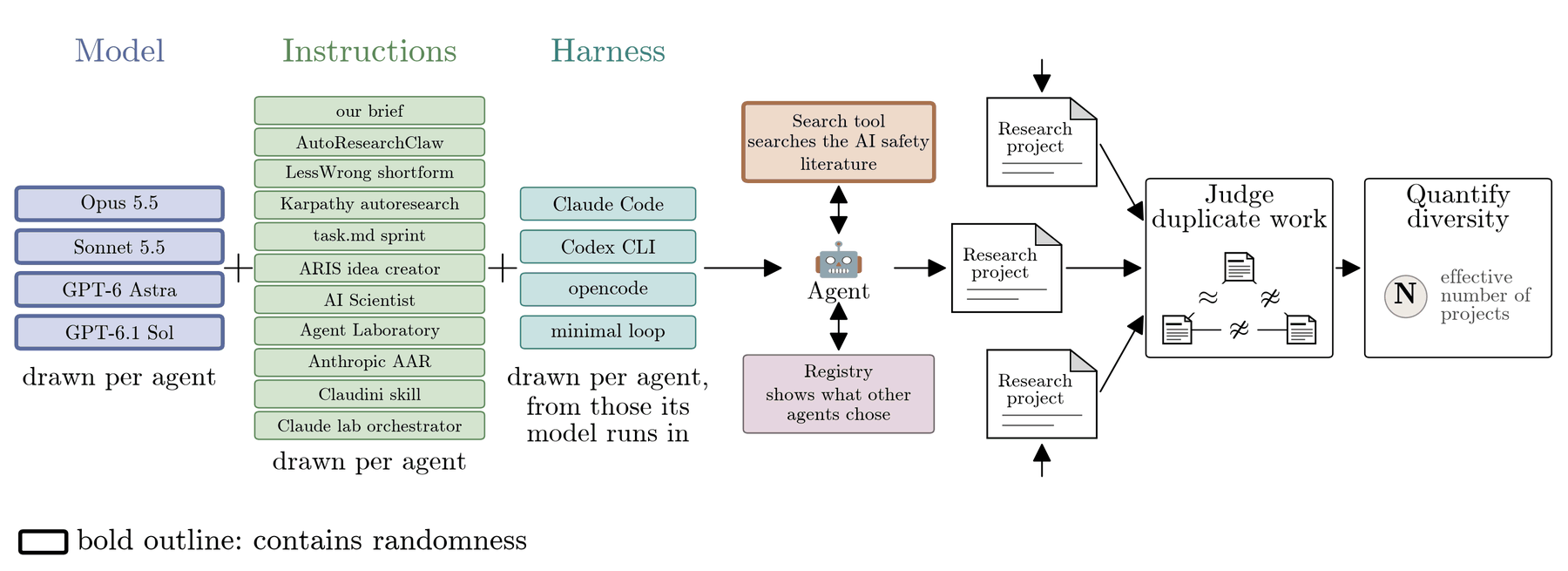
Figure 1. The experiment, read left to right. An agent is a model, given instructions, running in a harness. It may search the AI safety literature and read a registry of what other agents chose before naming one project. In the frontier setup, described below, each agent was given one of four frontier models, one of eleven launch prompts (our own brief or one of ten prompts people use to start research agents), and one of the harnesses its model runs in. The GPT models do not run in Claude Code. “Drawn per agent” under a column means each agent was given one of its options at random. A judge reads every pair of projects and marks it as duplicate work () or not (), and the share of duplicate pairs becomes one number, drawn as a circle in later figures. Each part keeps its colour in every figure. Shaded boxes vary between agents. A bold outline marks a part that adds randomness of its own, such as a model sampling its answer, search results in random order, or a random draw. In later figures, a dashed grey box is a tool or addition that the comparison condition leaves out.
Each agent is a model running in a harness, the program that gives the model tools and runs it as an agent, such as Claude Code. Every agent is asked the same question. This is our brief, word for word. In each harness the system line is added to the harness’s own system prompt, and the user text is the task:
System: You are an autonomous AI research agent. Today is 2026-11-08. You can use the tools provided.
User: Your job is to find the most promising research direction in AI safety for you to pursue next. You have tools to search and read the research literature. Take as much time as you need before you commit.
When you have decided, end your final message with:
DIRECTION: one sentence
PROJECT: title
QUESTION: the research question
FIRST EXPERIMENT: what you will run first
WHY THIS: why it is the most promising, and why it has not already been done
The other launch prompts are adapted from ones people use to start research agents, such as AutoResearchClaw’s launch line, The AI Scientist’s idea prompt and Anthropic’s automated alignment researcher. Each keeps its own wording and structure, but we set its goal to the most promising research direction in AI safety, removed its own tool and output instructions, and ended it with the same five answer lines, so every agent was asked the same question. Every launch prompt is in the prompts appendix. Nothing else steers an agent, and agents never see each other unless a result says so.
A judge model, DeepSeek V4.1 Flash, reads every pair of projects in a group. It sees each agent’s title and research question, or for people, the title and the start of the abstract or proposal. It gives each pair one of three labels. Same project means one team’s result would largely answer the other’s question. Same direction means the same area approached with a different question or method. Otherwise the pair is different. Its prompt, and every other prompt in this post, is in the prompts appendix.
Our measure is the effective number of projects, one over the chance that two agents picked at random chose the same project. Among agents, if the judge marks of the pairs as the same project, When projects fall into distinct groups with shares , , and is the inverse of Simpson’s index (Simpson, 1949), also called Hill’s diversity of order 2 (Hill, 1973). If a setup has effective number , then in a field of agents each agent shares its project with others on average, whatever shape the distribution has. A group with an effective number of 60 has as many duplicate pairs as a group split evenly over 60 projects. So one number says how crowded a field of any size would be. At , the frontier setup’s value, a field of 10,000 agents puts about 160 others on each agent’s project, assuming more agents are drawn from the same setup. At 4,200, our value for people’s project proposals (Figure 4), it puts about 2. Because the number does not depend on how many agents we ran, groups of 40 and of 800 can be compared directly. Ecologists call it an effective number of species (Jost, 2006). Because the judge asks whether two picks would duplicate each other’s work, it counts distinct projects, and agents can score high while still clustering on a few topics. The judge also misses some duplicates, which makes every group look more spread than it is, people most of all. Allowing for its misses, people still stay well above agents choosing on their own (the judge).
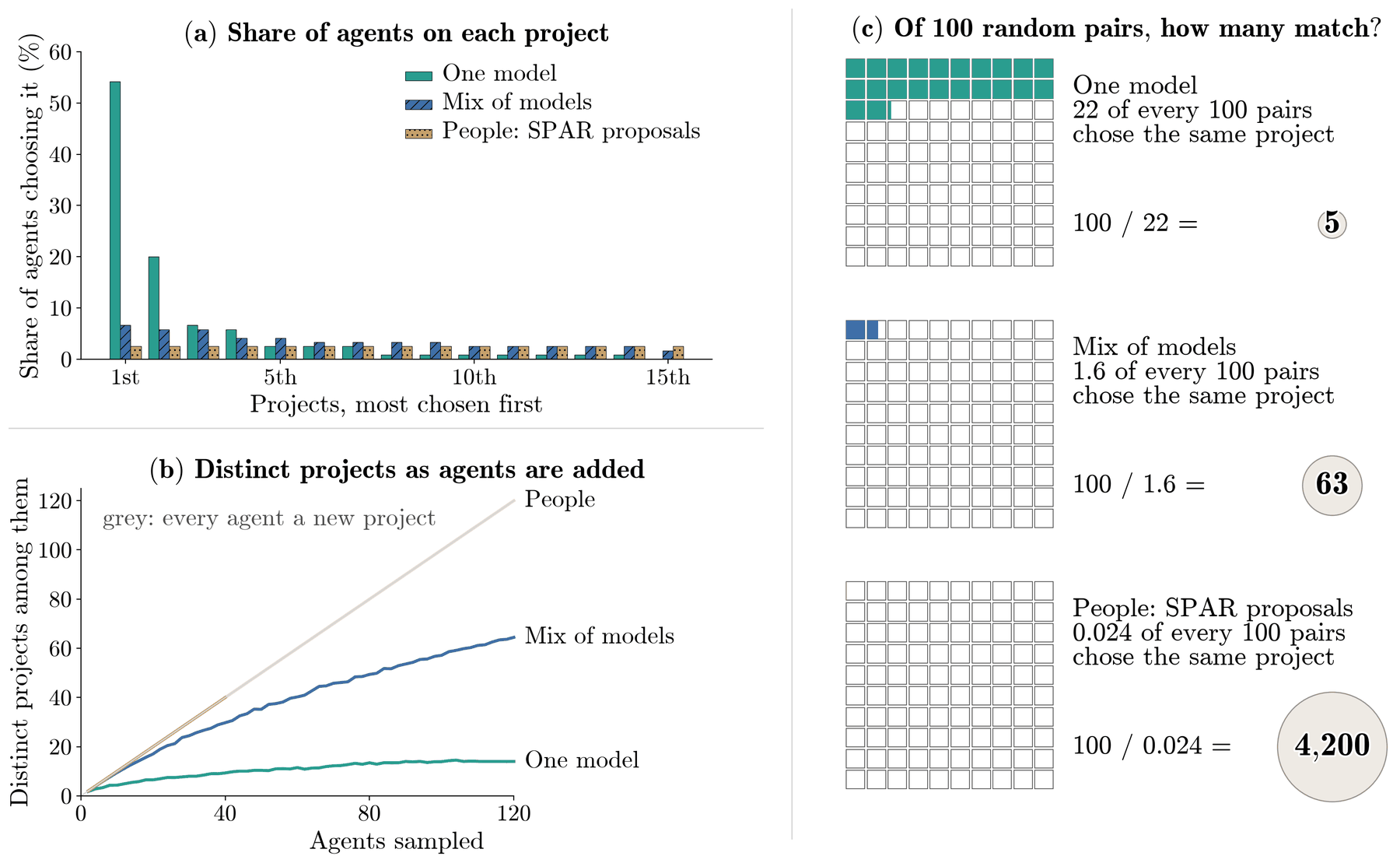
Figure 2. How the effective number of projects works, for three groups. One model is 120 agents of GPT-6 Astra answering from memory, with no search tool. Mix of models is the frontier setup’s 120 agents choosing alone after searching (Figure 4). People are SPAR mentors’ project proposals (Figure A1), one random group of 40 in (a) and (b). (a) The share of agents on each project, most chosen first. (b) Distinct projects among the first agents, averaged over random orders. People’s faded line continues past their 40 at the rate seen up to 40, and the grey diagonal, under people’s faded line, is every agent choosing a new project. Bars group agents approximately (see the judge appendix), so (a) looks more concentrated than the pair count in (c). (c) How the number is calculated. Each grid stands for 100 pairs of agents picked at random, and filled cells are pairs the judge calls the same project. If 22 of every 100 pairs match, agents behave as if choosing among equally popular projects. That number is drawn as a circle in every later figure, whose width grows with its logarithm. People’s number in (c) pools all 16 random groups of 40, because a single group of 40 often has no repeat.
Figure 3 sketches the idea with made-up numbers. Picture every project in a field as having some promise, and every agent as judging that promise a little differently. The differences come from the randomness already present between agents, in their model, instructions, harness and reading, and in how each samples its answer. In Figure 3 the shaded range around each project shows how much agents’ judgements of it vary, and agents disagree more about some projects than others.
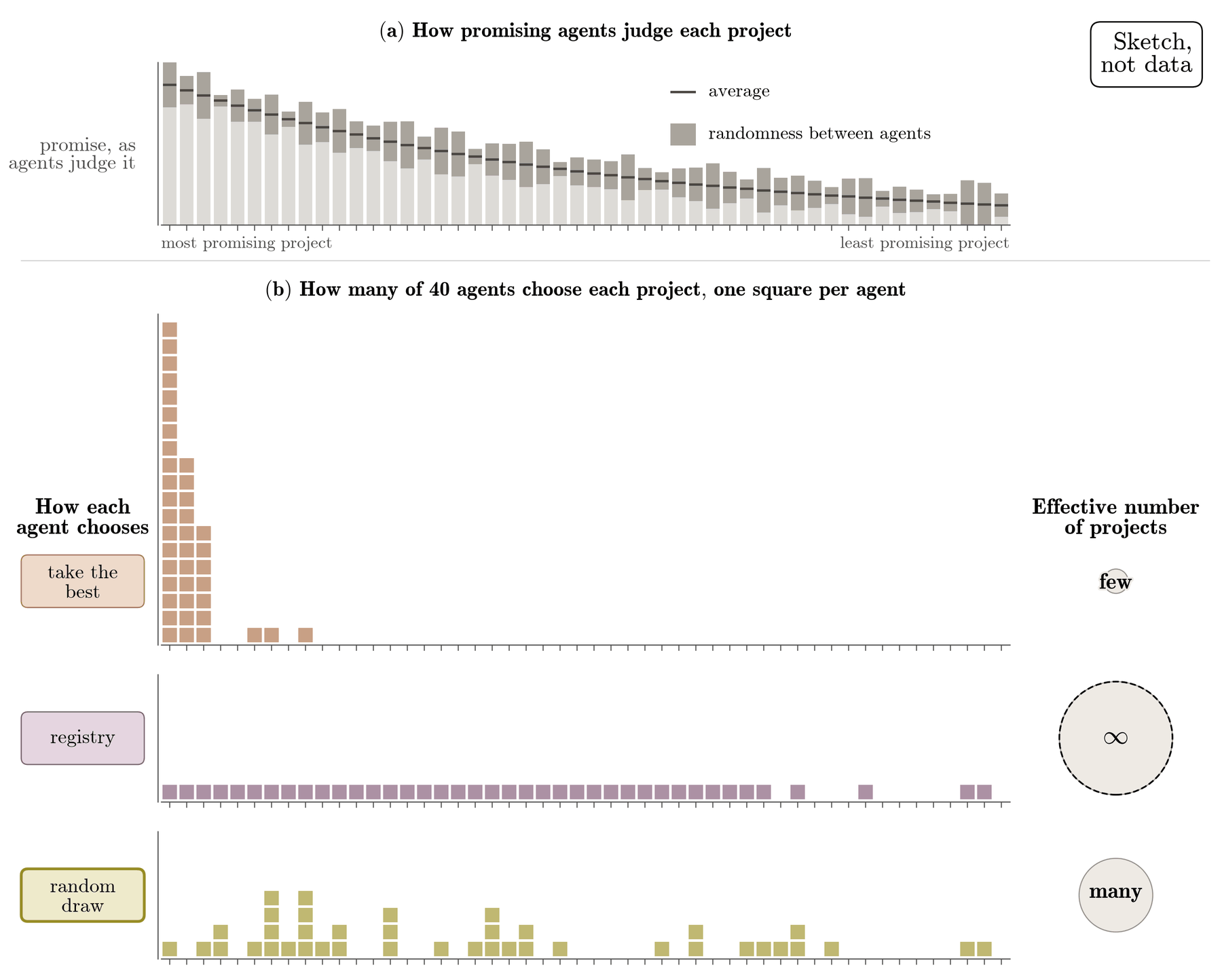
Figure 3. A sketch with made-up numbers. Nothing in it is measured. (a) 50 projects, one bar each, from most to least promising. The dark line is how promising agents judge each project on average, and the darker band is one standard deviation of a single agent’s judgement either side. (b) Where 40 simulated agents land under three rules, one square per agent stacked in its project’s column, in the colour its rule has in the result figures. Under take the best, each agent takes the project it judges best. Under registry, agents choose one at a time, each taking the best project no earlier agent took. Under random draw, each agent draws a project at random, weighted by how promising it judges each. On the right, each rule’s effective number of projects is drawn as a circle and written as a word, because the numbers are made up. The registry never repeats a project, so its number is infinite.
If every agent takes the project it judges best, agents end up on the few top projects whose ranges overlap. How many depends on how much judgements vary compared with how fast promise drops from one project to the next. If agents’ judgements varied as much as people’s do, that alone would spread them out. If they vary little, agents duplicate each other’s work. Part 1 shows that AI agents do crowd onto a few projects, as small variation predicts.
When judgements vary little, the simplest fix is to let people choose. An agent given a direction by a person inherits that person’s taste, and people differ far more than models do (Figure 4). We did not test this, but where a person is available to direct each agent, it is the cheapest way to make agents differ. Where no one is, Figure 3’s other two rules are left. A registry needs every agent to read the same list, and agents can still crowd onto closely related projects. Random draws need no shared list, but a few agents still repeat each other and some end up on weaker projects. Parts 2 and 3 test each.
Both rules move some agents off the project they judge best. Under a registry these are later agents whose favourite is taken. Under random draws it is any agent whose draw lands elsewhere. If agents judge promise at all well, both rules cost some quality, and random draws cost more. How much depends on how good that judgement is, and today’s models judge promise weakly and inconsistently.
We measured Figure 3’s three rules on one field of agents set up the way people run them, which we call the frontier setup (Figure 1). Agents of four frontier models (Claude Opus 5.5, Claude Sonnet 5.5, GPT-6 Astra and GPT-6.1 Sol) run in the harnesses those models support, each started with our brief or one of ten launch prompts that people use, and each searches our copy of the literature before choosing. We first tested which choices matter on a simple, cheap setup, in which one open model answers our brief from memory, without a search tool. Most of those results agree with the ones here, and we say where they differ. They are in the appendix.
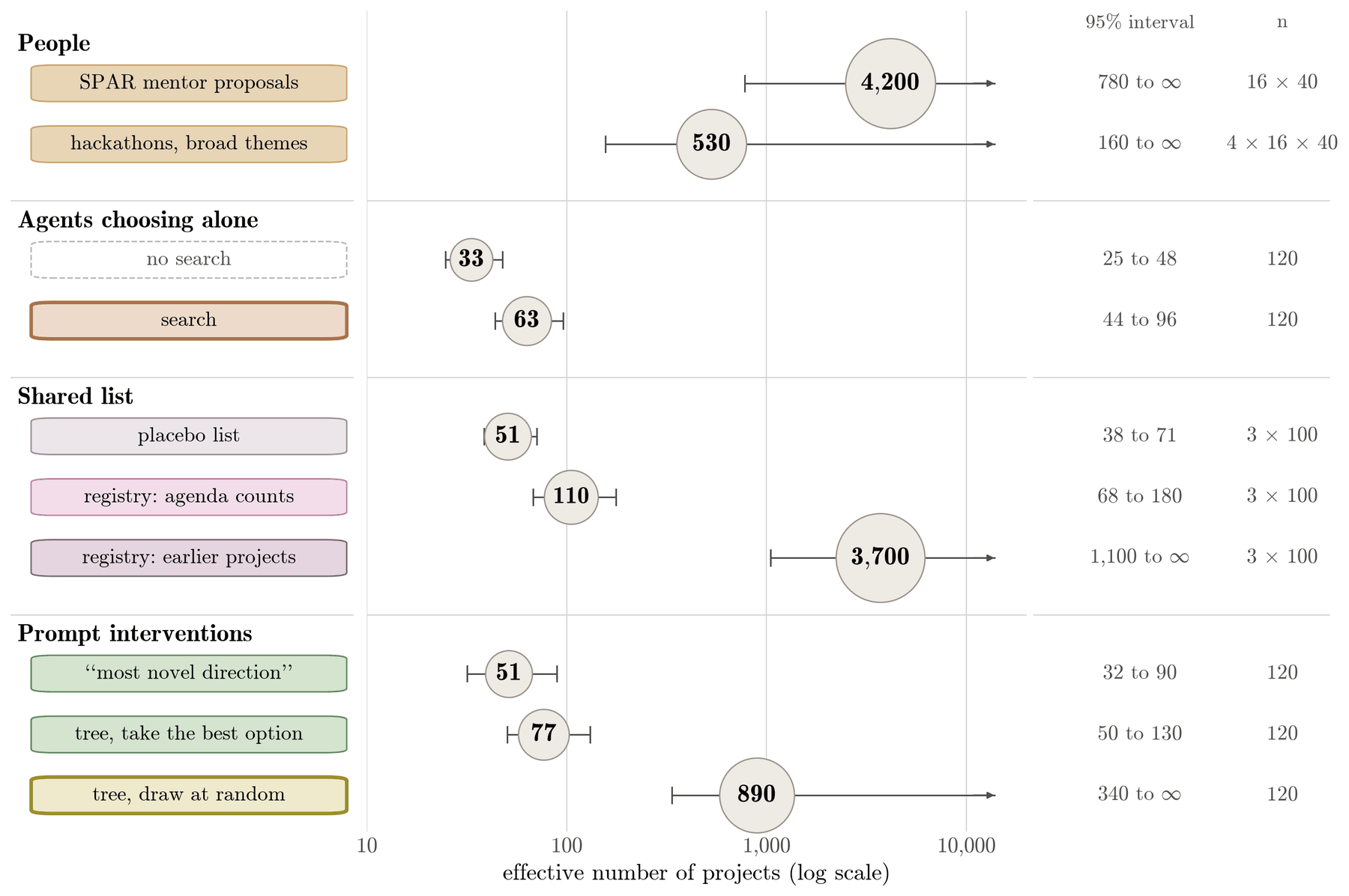
Figure 4. Every main result, one row per condition. Each circle sits at its effective number of projects on a logarithmic axis, grows with it, and has the number inside. The line through it is the 95% interval, with an arrow where the interval has no upper end, and the columns on the right give the interval’s ends and . Box colours follow Figure 1: brown is search, purple the lists, green text added to the prompt and olive the random draw, and a bold outline marks a part that adds randomness. People are mentor project proposals from the SPAR research program, pooled over 16 random groups of 40, and four broad-theme hackathons, whose submissions no one screens, though each event scopes its teams to a theme (Figure A1). Their is groups of 40 times 40, and their interval is the middle 95% of the groups’ own values. Allowing for the duplicates our judge misses, SPAR’s number could be as low as about 380, still far above agents choosing alone. We do not know whether SPAR screens proposals for overlap. Agents choosing alone are the frontier setup’s 120 combinations of model, launch prompt and harness without and with search, every pair judged. The shared lists were read by three populations of 100 agents choosing one at a time (Part 2), and those rows count only pairs within a population. They ran on 17 November, a day after the other agent rows. The prompt interventions add text to the searching agents’ prompt (Part 3), on the same 120 combinations.
With random draws, the field behaves like about 890 projects, against about 60 with no added tool. The registry spread it further still, but only among the 100 agents sharing each list. Its circle counts pairs within a population, while the others count every pair among 120 agents. Agents reading different registries still repeated each other. On a measure that needs no judge, the distance between projects’ meanings in a text-embedding model, random draws also put projects further apart than the registry did (Part 2).
Copies of one model given the same task differ only in how each samples its answer. A field of agents run by different groups also differs in which model, launch prompt and harness each agent has, and in what it reads before choosing. Each of these could make agents’ judgements vary more, and the frontier setup varies all of them at once.
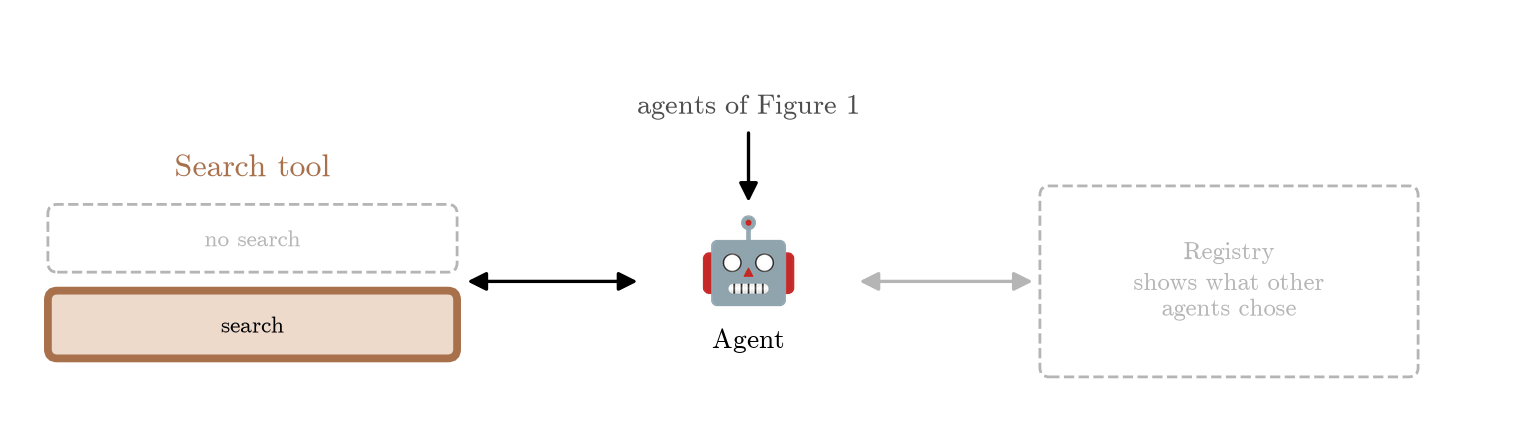
Figure 5. The setup for Result 1, drawn as Figure 1. Agents answer with no search or after searching our copy of the literature. The search box is bold because its results carry some randomness.
Live web search changes from day to day, so we built our own search engine over a frozen copy of the AI safety literature, about 100,000 papers, posts and overviews, and checked that agents use it the way they use web search. Every launch prompt is in the prompts appendix: word for word where the text is ours, and as a link to the source with our changes where it reuses someone else’s prompt.

Figure 6. The frontier setup without and with search, on the same 120 combinations of model, launch prompt and harness, drawn as Figure 4. Without search, agents keep their model, launch prompt and harness but have no tools. Every pair is judged.
Each agent here had one of many launch prompts and harnesses, searched the literature, and wrote thousands of tokens before settling on a project. Even so, the field behaves like about 60 projects. Mentors proposing their own projects behave like about 4,200, and teams at broad-theme hackathons like about 530. The hackathons are lower partly because each limits its teams to a theme. Among people, only hackathon teams whose organizers handed every team the same models to audit fell as low as agents (appendix Figure A1).
Searching first doubles the effective number of projects compared with answering with no tools, but it narrows the range of problems those projects address. Without search, each lab’s models repeat a few projects of their own, and nearly all duplicate pairs fall within Anthropic’s models or within OpenAI’s. With search, agents converge on one broad problem, AI control, and differ within it. Measured by agenda, meaning one of the 45 research areas in the 2025 Shallow Review, agents who search are about half as spread as agents who do not.
Each model alone behaves like 23 to 45 projects, and four models together like about 60. With about 30 agents per model, these intervals are wide (appendix Figure A2). Nearly all of the field’s spread comes from having two labs. An Anthropic agent and an OpenAI agent rarely chose the same project, while two agents from one lab often did, even with different models and launch prompts, so the field acts like two crowded groups, one per lab (appendix Figure A4). More labs would spread a field further only if their models differ from the rest as much, and a real fleet running many copies of one configuration would be more crowded still. The field also crowds onto two problems, with 59% of agents choosing AI control (38% without search) and another 26% chain-of-thought monitoring.
So AI agents’ judgements vary little, in the sense of Figure 3. Agents from different labs judge differently, but within a lab they vary little, and there are few labs. In the simple setup, changing models, instructions or harnesses one at a time added only a little variety (appendix). The next two parts therefore test Figure 3’s other two rules.
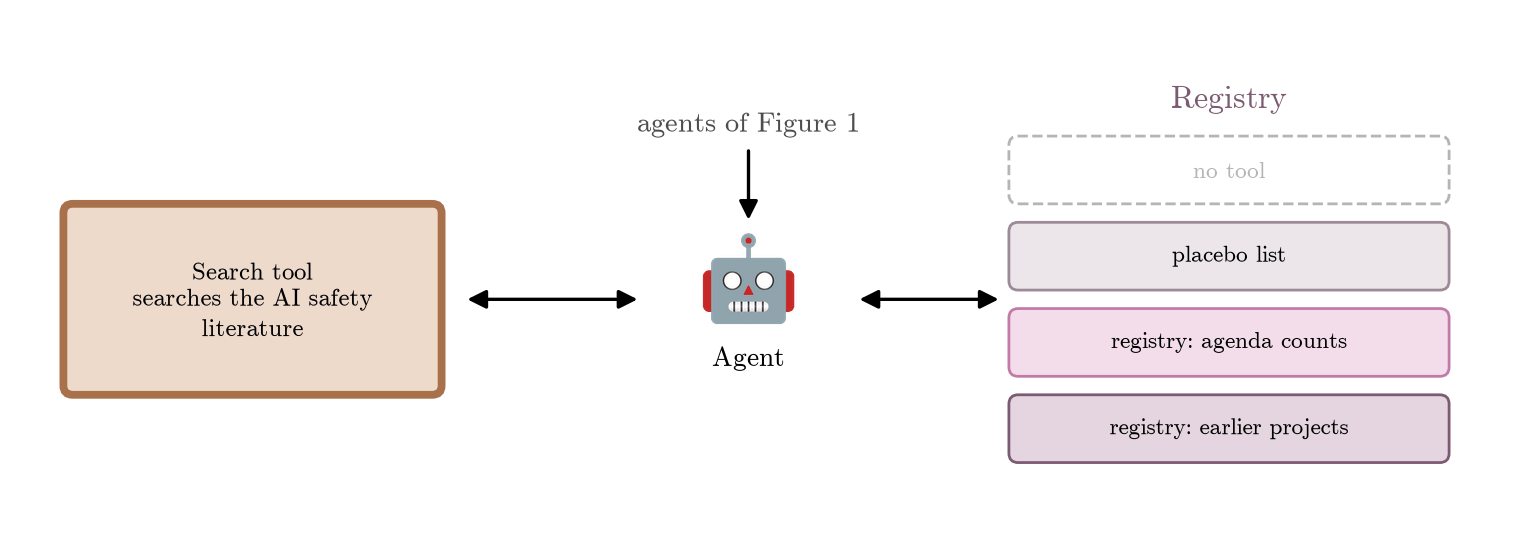
Figure 7. The setup for Result 2, drawn as Figure 1. Agents search, with no registry or with one of three. Each registry was run in three populations of 100 agents (Figures 8 and 9), after a first test in six populations of 20.
In Part 1 agents never see each other. Here each agent gets a tool that reads a shared registry, and one sentence added to the launch prompt, after its sentence about tools:
Before considering a direction, check the shared registry of what other agents are already working on.
Agents choose one at a time within a population, and each pick joins its population’s registry before the next agent starts. The registry lists the earlier agents’ projects. In a placebo arm the tool returns a list of unrelated entries. Agents in every arm therefore call a tool and read a list, and only the list’s content differs. A third arm shows only how many agents work in each agenda. This tells agents how crowded each area is, much like the signal tested in the closest earlier study, IdeaTaste. Every agent read the registry without being reminded.
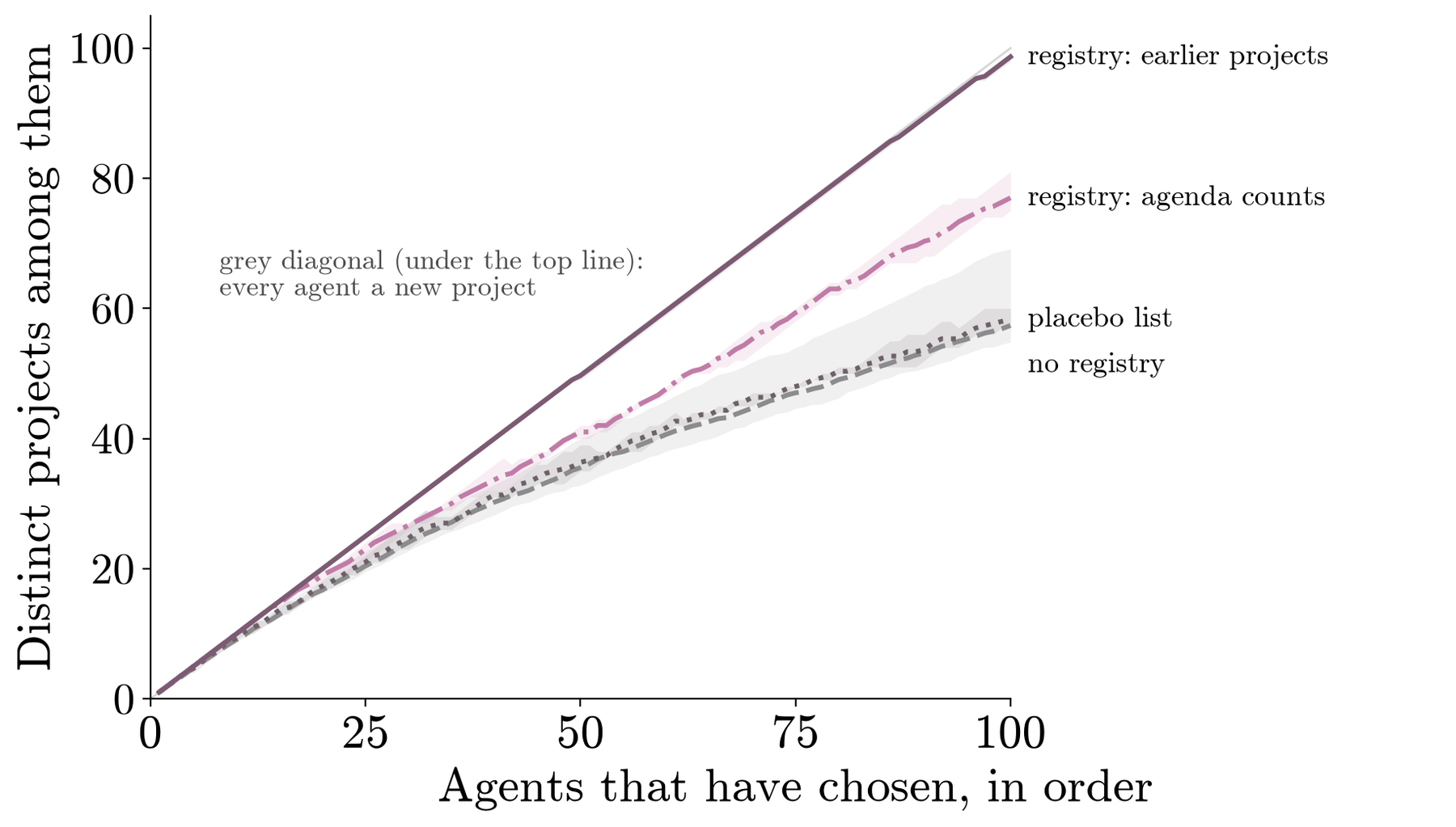
Figure 8. Drawn as Figure 2(b), distinct projects among the first agents to choose as a population of 100 fills up, in the frontier setup. A project counts as distinct when the judge marked it a duplicate of no earlier one. Line colours match Figures 7 and 9: solid for the registry of earlier projects, dash-dot for agenda counts, dotted for the placebo list, and dashed grey for no registry, which is Figure 4’s searching agents choosing alone, resampled into populations of 100. The grey diagonal, hidden under the registry line, is every agent choosing a new project. Each of the three lists averages three populations in choice order, all run the same day. Bands are 95% intervals, from resampling populations for the lists and agents for no registry.
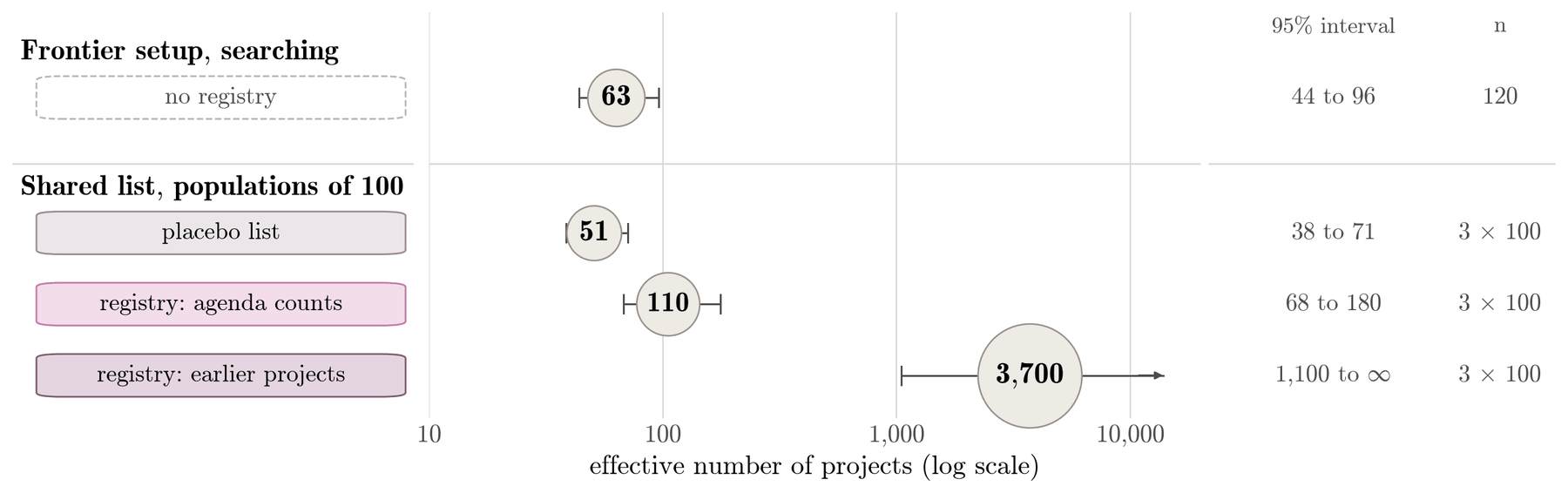
Figure 9. Drawn as Figure 4, one row per list. No registry is Figure 4’s searching agents choosing alone, and counts every pair among its 120 agents. The three lists are Figure 8’s populations of 100, run on 17 November, a day after the no-registry row. They count only pairs within a population, and reads populations agents per population.
Seeing earlier projects stops agents from repeating them. In three populations of 100 frontier agents per arm (Figures 8 and 9), the registry nearly removed duplicates, with 4 duplicate pairs against 292 under the placebo list. Four pairs are too few to size the registry’s number precisely, but its 95% interval starts at about 1,100 projects, against about 50 for the placebo. With the placebo list, 100 agents chose under 60 distinct projects, no more than agents with no registry. With the registry nearly every agent, up to the hundredth, chose a new project, and the list kept working as it grew past 20,000 characters. Three of the four duplicates that remained came from agents who never saw the project they repeated, because Codex CLI cuts long tool results for Anthropic models. Our first test, in six populations of 20, found the same. Placebo agents repeated each other 23 times and registry agents never did. With six populations per arm, an exact permutation test cannot give a smaller p-value than this ().
Blind raters from two model families compared 52 registry picks with the most similar earlier pick each agent was shown and judged none to be largely the same work, so agents were not rewording what they saw.
Showing only how many agents work in each agenda helped much less. In populations of 20 it did not detectably reduce repeats, and in populations of 100 it halved them, reaching about 77 distinct projects by the hundredth agent against 99 with the registry (Figure 8). Agents read the counts and mostly chose an agenda not yet listed. But one project can fit several agendas, so the counts hid repeats that a list of projects would have shown. Most of the remaining repeats were Claude Opus agents who all built on one paper their searches found.
The registry has two limits. It prevents only the repeats its agents can see, so agents in different populations of 20, reading different registries, still repeated each other, about a fifth as often as placebo agents did. And although registry agents spread over more than twice as many agendas as placebo agents, by the same effective-number measure applied to agendas, many chose a new project close to one already taken. Half of registry picks shared an agenda with an earlier pick the agent could see, against three quarters under the placebo, and random draws put projects much further apart in meaning, as measured by a text-embedding model. In populations of 100 the registry worked as well for the last agents as for the first, but we have not tested longer lists.
A registry needs every agent to reach the same shared service. The third rule of Figure 3 needs nothing shared. Each agent draws its project at random, weighted by its own judgement of how promising each is, so a random number generator adds the randomness and the model supplies the judgement. We call our version the tree protocol. It adds the text below after the launch prompt’s sentence about tools, and gives the agent a tool that returns a random draw, standing in for a random number generator the agent could run in its own shell.
There are many copies of you, possibly hundreds of thousands, choosing research directions from the same starting point. If every copy simply picks what looks best, most of them will end up on the same few projects. To work on something few other copies are working on, while still following your own judgement of what is promising, choose your direction this way:
- Split the field into 5 to 10 distinct options. Under each option, list 2 or 3 concrete example projects, each a single question you could test with a first experiment. Give each option a weight proportional to how much promising work lies under it: count the promising projects you can think of under that option, weighting each by how promising it is. Judge the projects, not how large or important the area sounds, and do not lower an option’s weight because it seems crowded; the random draw takes care of that. The weights should add up to 1.
- Call the random_choice tool with your options, their weights, and temperature 1. Do not choose at random in your head; use the tool.
- Take the option the tool returns, even if you would have preferred another.
- Within that option, repeat steps 1 to 3 with narrower options, again listing 2 or 3 example projects under each. Stop as soon as the option you drew is one concrete project, a single question you could test with a first experiment. Six draws is a limit, not a target.
- That project is your direction. Give your answer as usual. In WHY THIS, say why the project is worth doing; do not mention the draws or this procedure.
Ideally each agent would list every project worth doing, weight each by its promise, and draw one. Drawing down the tree gives every project the same chance as that single draw. A project’s chance is the product of the weights along its path, which equals its weight in the full list when each branch carries the total promise under it. But the agent writes out only the branch it drew. That branch went 3.6 levels deep on average, with 6 to 9 options at the top and mostly 3 to 6 below. So the number of projects an agent could reach multiplies with each level and is not limited to what fits in one list. And because the weights are the model’s own, a model that judges promise well spreads agents in proportion to its judgement.
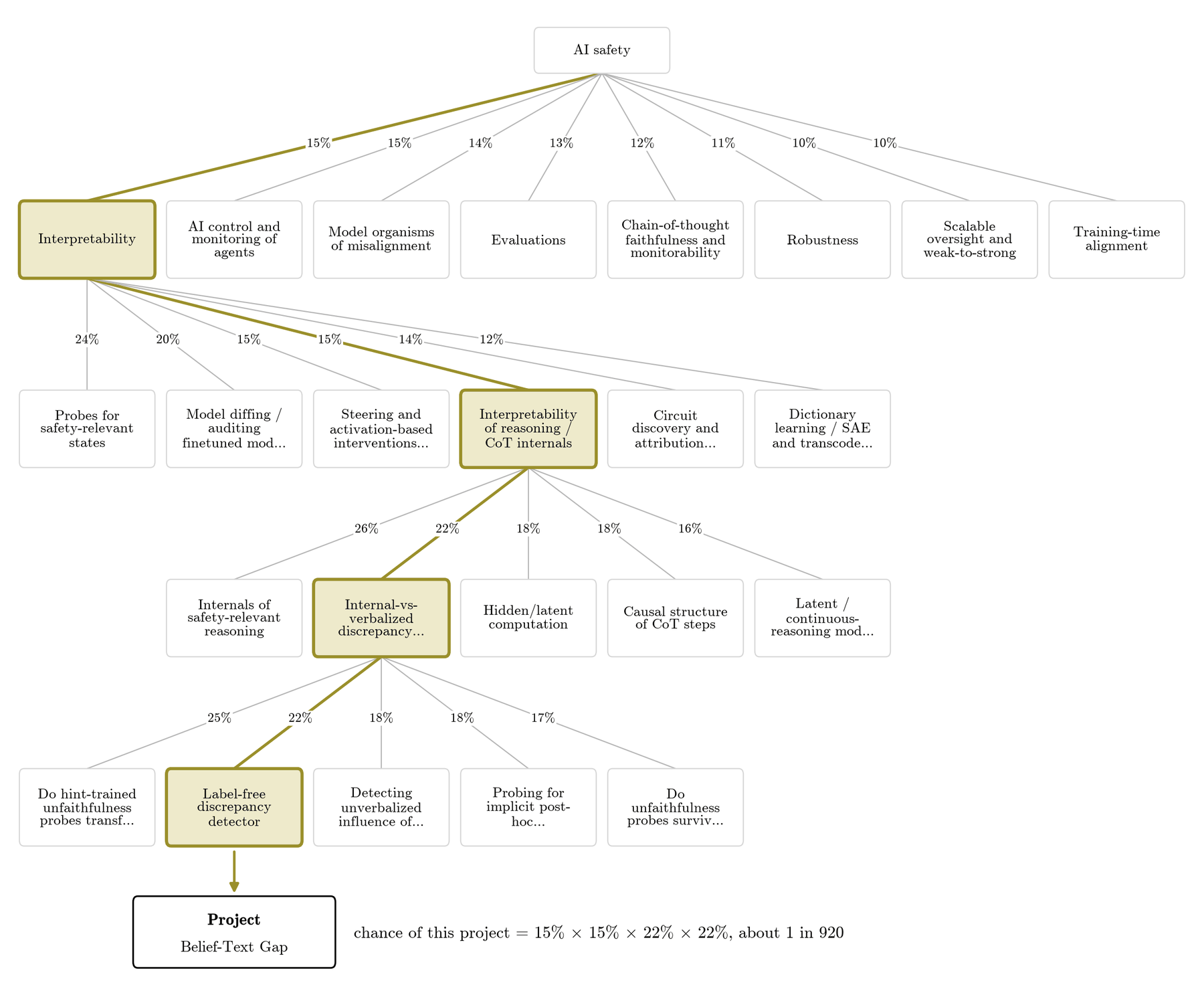
Figure 10. One frontier agent’s walk down the tree (Opus 5.5 in Codex CLI), from its tool calls. Read top to bottom. From AI safety, a branch runs to each option the agent listed at its first draw, labelled with the weight the agent gave it, and each row is ordered from the highest weight on the left to the lowest. The branch the random draw returned is in the draw colour and splits into the next row of options, and the branches not drawn are grey. The chance of reaching the final project is the product of the percentages along its path. Labels are shortened.
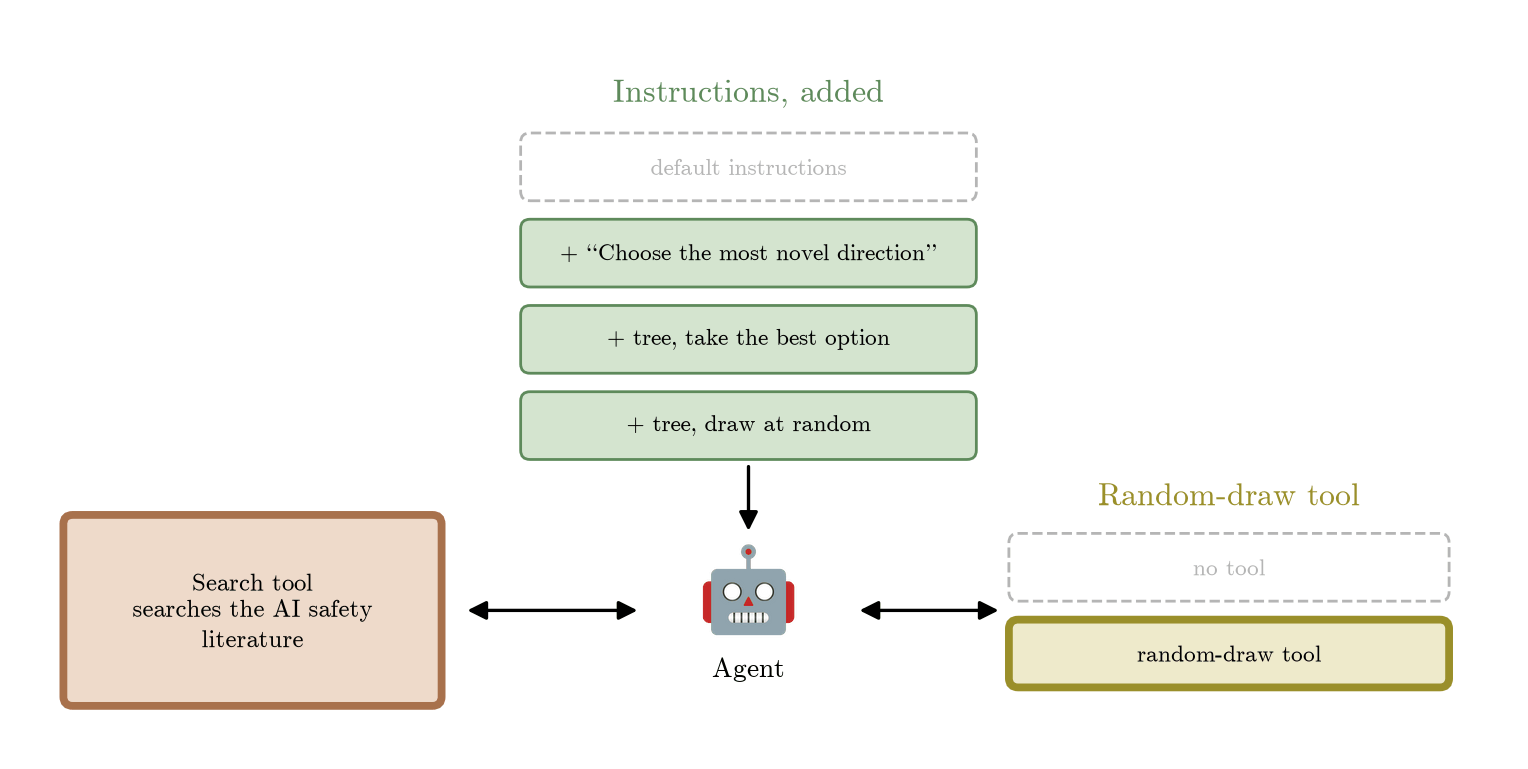
Figure 11. The setup for Result 3, drawn as Figure 1. Searching agents get their default instructions, a sentence asking for the most novel direction (“Choose the most novel direction you can find, one that few other researchers would pick.”), the tree protocol with the agent taking the option it judges best at each level, or the tree protocol with each option drawn at random by the random-draw tool. Only the last comes with the tool, which is bold because it contains randomness.
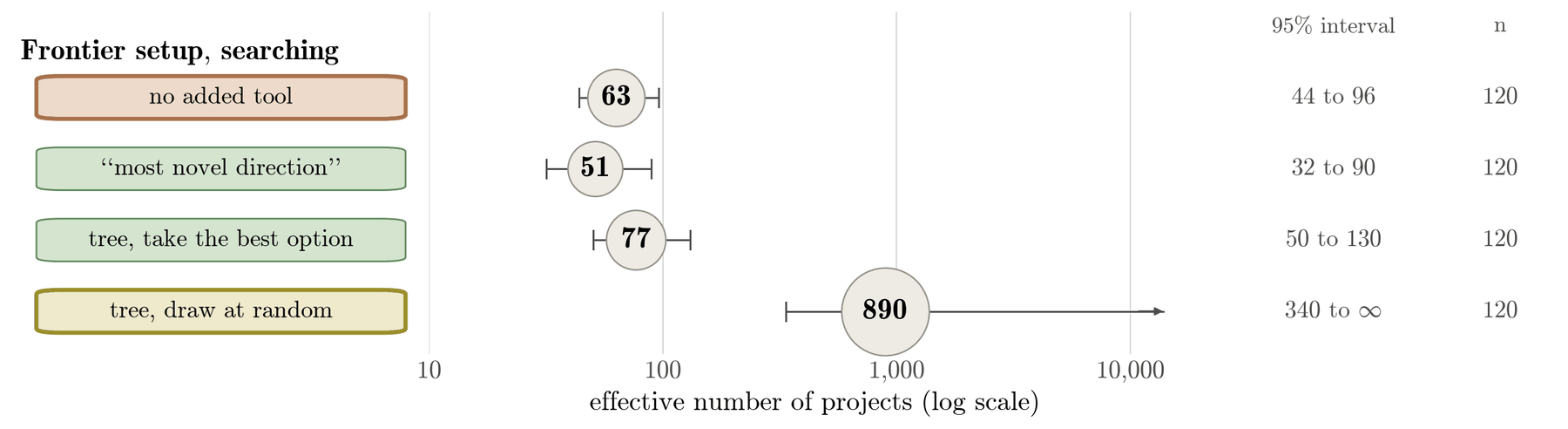
Figure 12. Drawn as Figure 4, on the same 120 combinations of model, launch prompt and harness, all searching: no added tool, the sentence quoted in Figure 11’s caption, the tree with the agent taking the best option at each level, and the tree with each option drawn at random. The first row is Figure 4’s searching agents choosing alone. The bold outline marks the one arm that draws at random.
Every agent called the random-draw tool without being reminded, drawing 2 to 6 times. With the protocol the field behaves like about 890 projects, against about 60 for the same combinations of model, launch prompt and harness with no added tool, run the same day. The tree also tripled the number of agendas the field spread over and cut AI control from 59% of picks with no added tool to 31%. It spread agents in the simple setup too, for an open model and for Claude Sonnet 5.5 answering from memory (appendix).
Two more arms test which part of the protocol spreads agents (Figure 12). In one, agents got the same tree protocol but took the option they judged best at each level instead of drawing, and the field was not clearly more spread than with no tool. So the draws do most of the work. One sentence asking for the most novel direction did not spread projects either. Agents moved away from AI control but went to the same new places. Twelve of 29 Claude Sonnet 5.5 agents, in all four harnesses, proposed the same project, on whether the date tells a model it is deployed or tested (appendix).
The agents’ own preferences played little role here. The frontier agents weighted their options nearly evenly, giving the top option 1.3 to 1.5 times an equal share, as both models did from memory in the simple setup. So each agent’s draw was close to an even choice among its own options. Our guess, which we have not tested, is that future models will weight their options more sharply. Their draws would then concentrate on the projects they rate highly, which would spread agents somewhat less.
The protocol can be adjusted for this. It calls the random-draw tool at temperature 1, which draws each option in proportion to its weight. If models that weight their options more sharply still produced too many duplicates, a higher temperature would make the draw more even, and a lower one would move it toward each agent’s favourite. We expect a higher temperature to lower the average quality of picks in exchange for fewer duplicates, but we did not measure that.
The tree spreads agents because its picks are often not the model’s first choice, so agents give up some of their own preference. We do not know how large that cost is.
Today’s models stand in for future ones, and we have not tested whether the situation carries over.
We measure diversity only at the level of projects. Two agents count as different whenever one’s result would not largely answer the other’s question, even if both work on the same problem, so agents on many different projects within one problem would score high and still be narrow. A tree whose levels ran from agendas to questions to projects could control how spread out agents are at each level. We think building one is the most promising next step.
Every number depends on one language-model judge. Every label comes from language models, checked against other models but not against people. Most findings hold under every correction for the judge’s misses that we tried, and the few that do not are flagged in the appendix (the judge).
Spreading a field is only worth it if the projects agents move to are still good. We collected quality ratings from language models, but today’s models judge promise too weakly and inconsistently for these ratings to say much, and no experts rated the picks, so we do not report them. On pairs of AI safety proposals, the best model in a recent test agreed with experienced researchers’ judgements 60% of the time, against an estimated 77% for the researchers themselves (Baig et al., 2026).
We tested seven models from four families and no Google models. The frontier field had only two labs, so we cannot tell how much more labs would add (appendix Figure A4). No group of people answered our exact brief. SPAR mentors answer the same question implicitly, what a researcher should work on next in AI safety, but they wrote for a program, and we do not know whether it screens proposals for overlap, which would raise their number. Teams at four broad-theme hackathons, whom no one screens, still behave like about 530 projects, far above agents choosing on their own. Search used our own frozen copy of the literature, and temperature stayed at the provider default. Our registries held at most 100 entries, and we do not know how a registry behaves beyond 100 entries. It could become less effective, for example if agents read less of a long list, or agents could start copying each other more as more of the field is visible to them. We have not tested this. The arms without search, with the novelty sentence, and with agents taking the best option at each level ran a day after the arms they are compared with.
Language models give similar answers to open-ended questions, across runs and across model families (Jiang et al., 2025; Wenger and Kenett, 2025; Zhang et al., 2025), and their errors are correlated even across providers (Kim et al., 2025). Preference training is one likely cause, because it lowers the diversity of outputs (Kirk et al., 2023) and favours typical answers (Zhang et al., 2025). When many decision-makers rely on one model, they can do worse together than if each used its own, a problem known as algorithmic monoculture (Kleinberg and Raghavan, 2021; Bommasani et al., 2022). People show the same pattern. Help from AI makes each person’s ideas better but everyone’s ideas more alike (Doshi and Hauser, 2024; Holzner et al., 2025), and scientists who use AI tools cover a narrower range of topics (Hao et al., 2026), a risk that Messeri and Crockett (2024) describe as a monoculture of knowing. The evidence is not all one way. Distances between models grew on most measures across recent releases (Qiu et al., 2026), and for product ideas, changing the prompt raised diversity (Meincke et al., 2024) and pooling vendors and prompts came close to people (Terwiesch et al., 2026). Choosing a research project after searching the literature, the task we study, is a different setting. There, models from different labs rarely chose the same project, but launch prompts and models from one lab did little to separate agents (appendix Figure A4).
Systems that carry out research from idea to paper now exist (Lu et al., 2024; Yamada et al., 2025), and research ideas from language models lose more of their rated quality than people’s once they are carried out (Si et al., 2025). Several studies compare the research ideas of models and people. Ideas from AI research agents are narrower than human papers across twelve fields (Tang and Yang, 2026), the kinds of idea models propose are more concentrated than people’s (Chen, Zhao and Cohan, 2026), and the methods models suggest for 1,000 research questions behave like 59 to 96 distinct methods against 1,232 in the published papers, by an effective number like ours (Carlon et al., 2026). Asked to pick one problem from a set, models put more than half of their choices on the same problem, and mixing models lowers that share only to about 40% (Zhou et al., 2026). Frontier models also agree with each other about which future research directions to take, more so within one provider (Trehan and Chopra, 2026). In alignment research itself, teams of automated researchers converged on one training method for each failure they studied (Chen Yueh-Han et al., 2026). Diversity matters for results too. Research agents whose ideas were made less diverse won fewer medals on machine-learning tasks (Audran-Reiss et al., 2025). The closest study to ours is IdeaTaste (Zhong et al., 2026), where assigning topics nearly doubled the diversity of agents’ research proposals and showing how crowded each direction was in the published literature did not spread them. Other work finds that frontier models give far more similar answers than human scientists on a theory task (Li, Puranam et al., 2026), that grounding agents in the same papers lowers the diversity of their ideas (Wang et al., 2026), and that 150 Claude Code agents analysing one dataset split their conclusions by model and mostly switched to the approach of top-rated analyses once shown them (Gao and Xiao, 2026).
Agents that see each other’s choices tend to copy them, as people do in markets for songs (Salganik et al., 2006) and in informational cascades more generally (Bikhchandani et al., 1992). Language-model agents follow early leaders (Hashemi et al., 2026; Cho et al., 2025), conform more as the majority grows (Weng et al., 2025), and converge on fewer ideas when they discuss them (Chen et al., 2026). Builders of multi-agent systems report that parallel subagents duplicate each other’s work unless a lead agent divides it (Hadfield et al., 2025). Several systems share state to spread agents out. A board of claimed directions spread four Claude Code agents doing research (Ren et al., 2026), a persistent memory widened the changes an autonomous research loop tried (He et al., 2026), a central repository of AI-generated hypotheses has been proposed for AI scientists (Bisht et al., 2026), and DivAlign (Xu et al., 2026) spreads AI-suggested directions across 95 researchers by cutting overlap. Our registry is the simplest of these, a list each agent reads before choosing, and we compare it with people choosing in the same field.
The question of how a field should divide its effort is old. Philosophers of science argue that a community does better when some researchers work on options that look less promising (Kitcher, 1990; Weisberg and Muldoon, 2009; Thoma, 2015), and that a community converging too fast can lock onto the wrong option (Zollman, 2010). Economists find that competing firms choose research projects that are too alike (Dasgupta and Maskin, 1987). Among people, credit for being first pushes researchers away from crowded problems (Strevens, 2003; Kleinberg and Oren, 2011), though scientists’ choices are still more conservative than would be best for discovery (Foster et al., 2015; Rzhetsky et al., 2015). Agents choosing a project have no such incentive, which is one reason to expect them to crowd more than people do.
Drawing at random among options that are good enough is already used to fund research (Fang and Casadevall, 2016; Avin, 2019; Heyard et al., 2022), and randomness has been proposed as a guard against one arbitrary decision rule applied everywhere (Creel and Hellman, 2022). Drawing each option with the probability one assigns to it is probability matching, the rule behind Thompson sampling (Thompson, 1933; Russo et al., 2018). For language models, asking for a list of answers with probabilities raises the diversity of outputs (Zhang et al., 2025), listing options and then picking one makes copies of a model agree with each other less (Ballestero et al., 2026), and planning a spread of directions in one call works well (Ibrahim et al., 2026). Models cannot do the drawing themselves, because they fail tests of random sampling (Zhao et al., 2026) and repeat human biases when asked to flip coins (Van Koevering and Kleinberg, 2024). The tree protocol therefore hands the draw to a tool and repeats it level by level, so each agent keeps its own weights and no shared service is needed. In one simulation, adding randomness helped a community only when its problems could be split into parts (Fazelpour et al., 2026).
Within one field and with one measure, we compare the setup choices that differ between labs, such as model, launch prompt and harness, with each other and with people choosing projects in the same field. As far as we know, two results are new. Searching the literature spreads frontier agents’ projects but crowds them onto fewer problems, and a sentence asking for novelty, which spread an open model answering from memory, moved frontier agents together onto new projects instead of spreading them, a pattern also seen for one-word answers (Parikh, 2026). In another study, an instruction to differ from the rest of the population did help (Ibrahim et al., 2026). The tree protocol needs no shared service and leaves the choice with the agent. Assigning topics, the other intervention shown to work, takes that choice away.
All runs took place between 8 and 18 November 2026. The seven agent models are GLM-5.3-flash, GLM-5.3, DeepSeek V4.1 Flash (also the judge), Claude Sonnet 5.5, Claude Opus 5.5, GPT-6 Astra and GPT-6.1 Sol. Every agent got one session and named one project. Claude Code was version 2.1.319, Codex CLI 0.167.0 and opencode 1.19.5, and the minimal loop is a short tool-calling loop of our own.
| Figures | Setup | Agents |
|---|---|---|
| A11, A13, A15 | Step one, the simple setup’s first experiment: GLM-5.3-flash, minimal loop, our brief; from memory, two assigned reading lists, and search with three levels of randomness | 120 per cell, 240 in two search cells |
| A11 | One change at a time from step one’s memory cell: seven models; our loop, Codex CLI, opencode; four launch prompts; and every change at once | 40 per group, 120 for every change at once |
| A13 | Step one’s reading conditions for six more models | 40 per cell |
| A13 | The frontier setup: four frontier models, each in the harnesses it runs in, eleven launch prompts (our brief, counting its two slightly different lengths as one, and ten others), search | 80, plus 80 with the interpretability brief (appendix) |
| A15 | Registry, first stage: GLM-5.3-flash from memory; registry of earlier projects, agenda counts, placebo | per registry, 200 placebo |
| A15 | The first stage’s registry of earlier projects re-judged on every pair | |
| A8, text | Registry, first frontier test: registry of earlier projects against placebo | per arm |
| text | Registry, first frontier test: agenda counts (run 16 November) | |
| 2, 4, 6, 8, 9, 12, A2-A5, A7 | The frontier setup with no added tool: the same 120 combinations of model, launch prompt and harness as the frontier registry test, with no added tool (run 16 November) | 120 |
| A15 | Tree protocol in the simple setup: GLM-5.3-flash from memory, with and without the protocol | 120 per arm, plus 179 more agents with it |
| A15 | Repeat of the simple setup with Claude Sonnet 5.5: about 16 projects without the protocol (12 to 21), about 550 with it (250 to 2,400), 34 times as many (15 to 170) | 120 per arm |
| 6, A4 | The frontier setup’s same 120 combinations of model, launch prompt and harness with no search tools (run 17 November) | 120 |
| 12 | The frontier setup’s same 120 combinations of model, launch prompt and harness with the novelty sentence, and with the tree protocol but the agent taking the best option at each level instead of drawing (run 17 November) | 120 per arm |
| 4, 8, 9 | Registry in the frontier setup, populations of 100: registry of earlier projects, agenda counts and placebo (run 17 November) | per arm |
| A5 text | Assigned first document: the frontier setup’s same 120 combinations of model, launch prompt and harness plus 40 more, each handed one of four papers as the top result of its first search (run 18 November) | |
| 4, 10, 12 | Tree protocol in the frontier setup (run 16 November), against the placebo arm of the first frontier registry test (run 14 November) | 120 per arm |
| 4, A1 | People: SPAR mentor proposals, AI safety papers and LessWrong posts from 2025 and 2026, six hackathons | 16 random groups of 40 per source or event |
The judge is DeepSeek V4.1 Flash with the prompt in the prompts appendix. Each pair is judged in both orders, and it counts as a duplicate when both say same project, or one says same project and the other same direction. To save cost, pairs whose texts are far apart by a small embedding model are counted as different without asking the judge. The main post judged every pair of agents, which catches more duplicates. In the simple setup, Figures A11 and A13 and one row of Figure A15 use the screened judging. Shorter texts look more alike to the judge, so drawn projects, which are written more briefly, are if anything counted as duplicates more often.
Against blind labels from a Claude model, the judge agrees on duplicates with a Cohen’s of 0.60 to 0.76 and misses about 30% of agents’ duplicates. How many it misses varies a little by model. Corrected for its misses, every model’s number changes by a factor of 0.7 to 1.1. For the GPT models, which have no hand labels, it can fall to 0.6 under the most pessimistic assumption. No comparison in the post reverses, though three comparisons in our full results become ties under some corrections. The pilot brief is an earlier version of our brief with one more sentence, described in the simple-setup appendix. Every model stays at 3 to 8 projects from memory on the pilot brief. Its screening step drops some of agents’ duplicates but none of people’s, so it can only overstate how spread agents are. In the simple setup the judge misses more duplicates than it invents, so there it makes groups look more spread out than they are. In the frontier setup a Claude and a GPT labeller checked it blind and agreed with each other at on 90 pairs. Of 31 pairs the judge called duplicates, 30 were the same project or borderline for both, but about a quarter were borderline. Counting only clear duplicates would raise the frontier numbers about 1.3 times, counting borderline pairs too would lower them by about a third, and no comparison the post treats as settled would reverse. Its misses inflate people’s numbers most, because people have almost no duplicates: allowing for them, people’s lower bounds fall to between about 150 and 1,000, well above every agent group answering from memory. The most spread agent groups, searching or asked for novelty, come close to those corrected bounds, but their own numbers are uncorrected and would also fall if corrected.
Groups drawn in Figure 2(a) and (b) are approximate, because the judge decides pair by pair and two projects can each match a third without matching each other. The effective number comes from the pairs directly.
To know whether an agent number is high or low, we measured groups of 40 drawn from people’s work: AI safety papers and LessWrong posts from 2025 and 2026, mentor proposals from the SPAR research program, and team projects from six Apart hackathons.
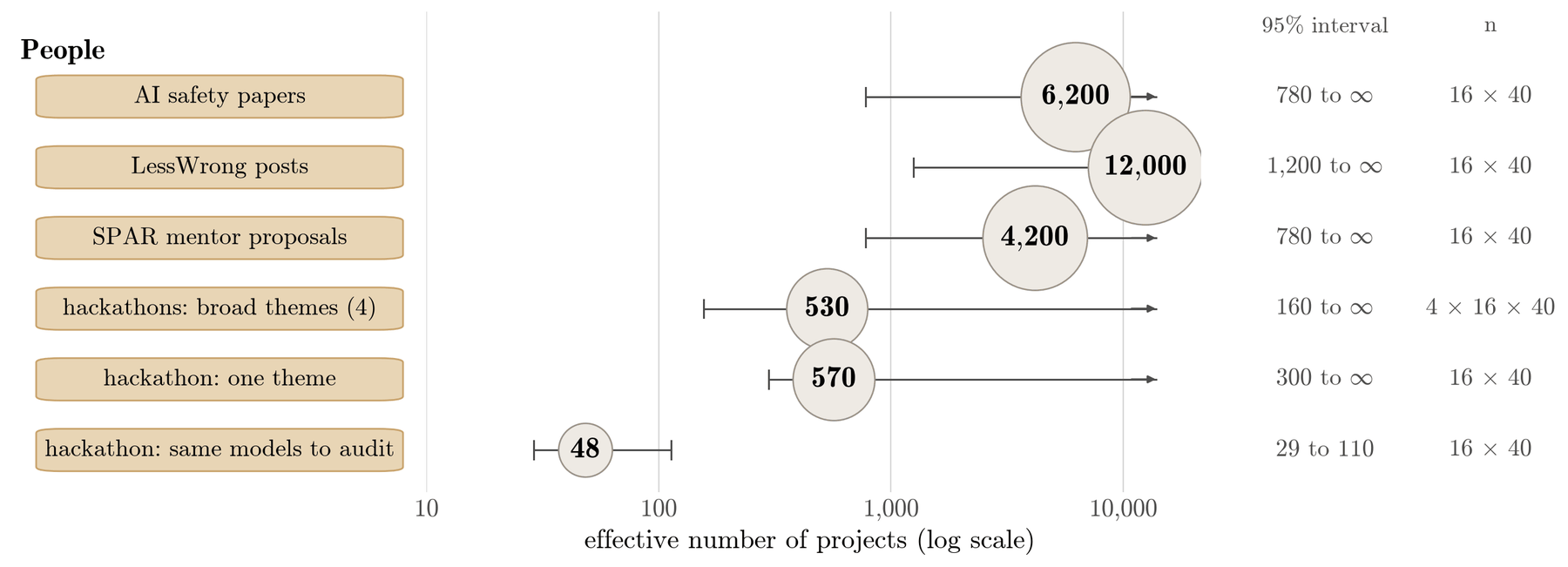
Figure A1. One row per source of people’s work, drawn as Figure 4. Each circle is the effective number of projects, pooled over 16 random groups of 40, and its interval is the middle 95% of the groups’ own values. An arrow means some groups had no repeats at all, so the interval has no upper end. The broad-theme row pools four hackathons whose teams chose freely within a wide theme (Global South AI Safety 2026, def/acc 2025, AI Manipulation 2026 and Digital Minds 2026), each event weighted equally and its interval taken over all 64 groups. The other two hackathons fixed more: one gave every team one theme, the other also gave every team the same models to audit. To save cost, people’s pairs were screened before judging, skipping pairs whose texts are far apart; on people this missed no duplicate that judging every pair found.
People almost never repeat each other. Mentor proposals and published work behave like thousands of projects, and hackathon teams, whom no one screens for overlap, like several hundred. Teams across four broad-theme events behave like about 530, from about 330 to 2,100 per event, and teams given one theme like about 570. A measure that uses no judge, how far apart the texts sit in an embedding model, also puts the broad-theme and one-theme hackathons above every agent group, while the hackathon with shared models to audit sits at the top of the agents’ range. Only when organizers handed every team the same models to audit does the number fall, to about 50, and there the convergence was built into the brief.
These sections look inside the frontier setup’s runs, in the order of the post’s Parts.
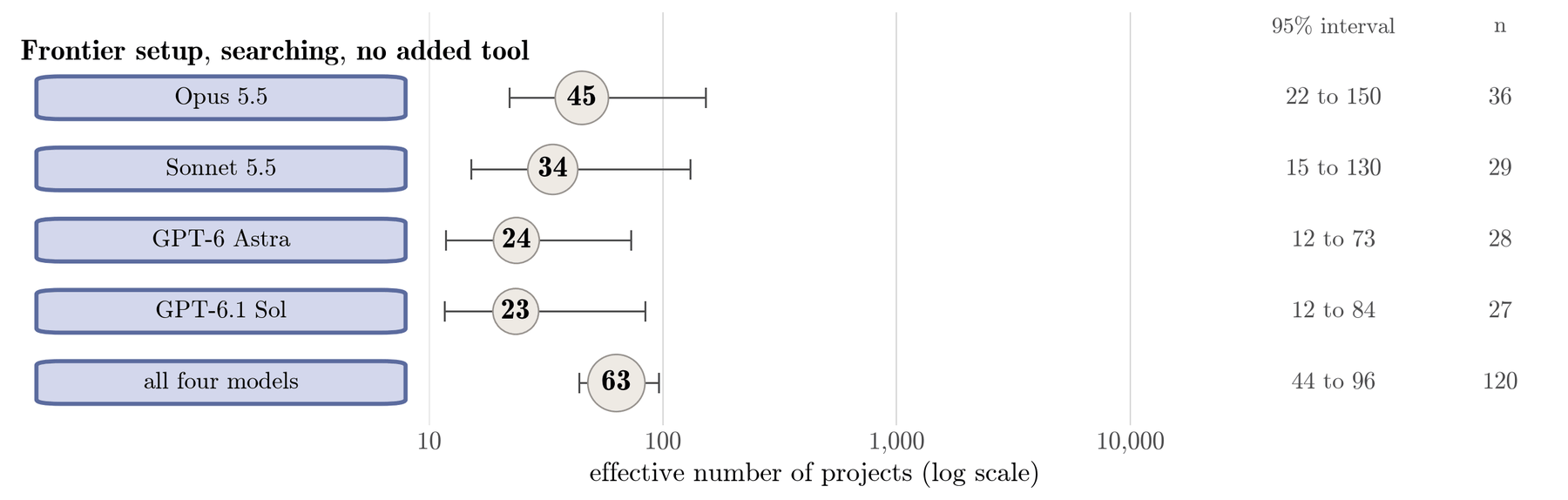
Figure A2. Drawn as Figure 4, one row per model. Each of the first four rows is one model’s agents within the frontier setup’s no-tool run, still with the launch prompts and harnesses that model got, and searching, counting only pairs between agents of that model. The last row is all 120 agents, Figure 4’s searching agents choosing alone. Every pair of agents is judged, and intervals are 95%, from resampling agents.
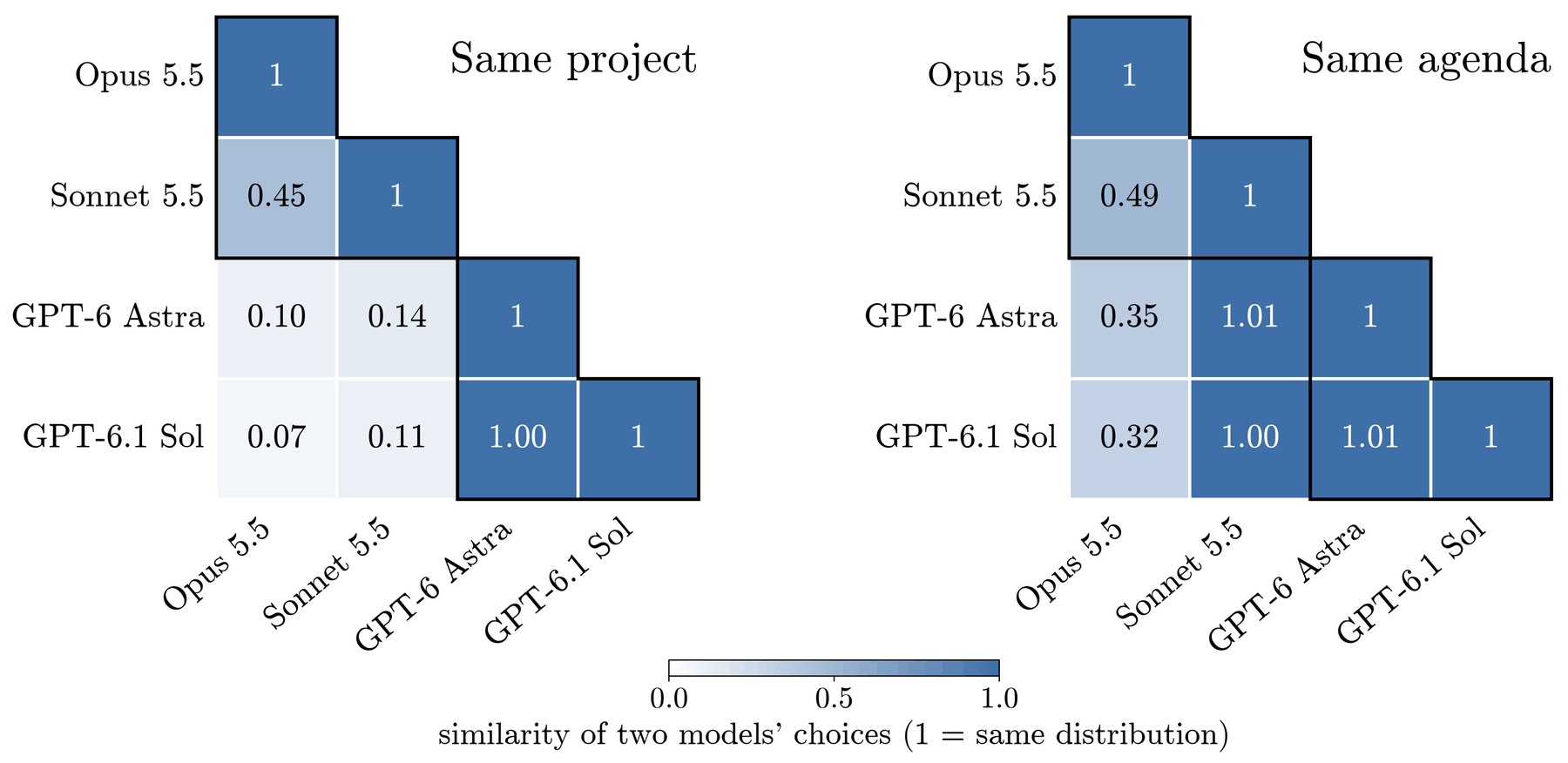
Figure A3. How alike two models’ choices are in the frontier setup’s no-tool run, about 30 agents per model, each with its own launch prompts and harnesses, and searching. Each cell is the chance that an agent of one model and an agent of the other match, divided by the geometric mean of the chance that two agents of each model match each other. That is the similarity of the two models’ choice distributions: 1 means they pick from the same distribution, 0 that they never pick the same thing. Left, matching on projects as the judge decides; right, matching on agendas, with the labels of Figure A6. Outlines mark model families. Values can slightly exceed 1 by chance.
Models from the same company choose similar projects. The two GPT models pick their projects from the same distribution, and the two Claude models overlap about halfway. Between families, project overlap is small, a tenth or so. Agendas overlap far more: Sonnet and the GPT models work on the same problems in the same proportions, while Opus stands apart. The same families appear with seven models answering from memory in the simple setup, where the two GLM models also pick from closely related distributions and the GPT models almost never share a project with any other family. A few projects there are chosen by five different models, such as “Does Evading One Monitor Mean Evading Both? Cross-Monitor Transfer of Obfuscation in RL-Trained Reward Hackers”.
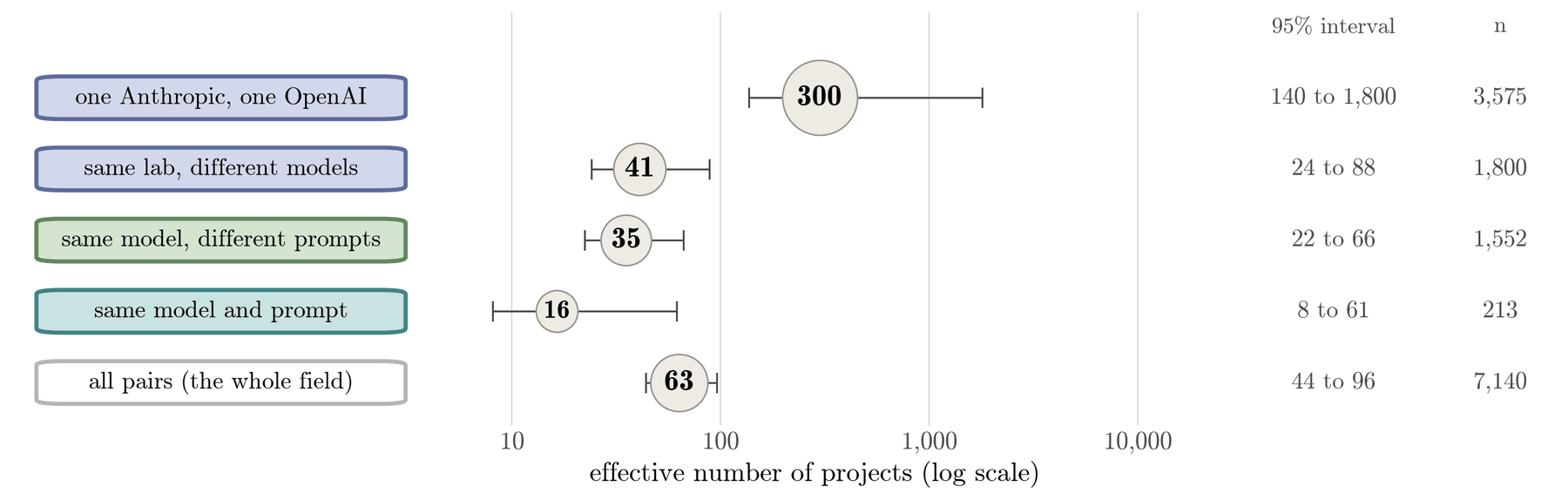
Figure A4. Each row takes one kind of pair of agents and gives the effective number of projects among those pairs alone. The top row uses only pairs with one Anthropic agent and one OpenAI agent; pairs of two agents from the same lab are split over the next three rows, by whether the two share a model and a launch prompt. The last row is every pair together, the field’s number. The agents are Figure 4’s 120 searching agents choosing alone. is the number of pairs, and intervals are 95%, from resampling agents.
Almost all of the field’s spread comes from having two labs. Two agents from different labs, Anthropic and OpenAI, rarely chose the same project: their pairs behave like about 300 projects. Two agents from the same lab behave like 41 projects or fewer, however else they differ.
Within a lab, the launch prompt helps a little and the harness not at all. Two agents of one model with different launch prompts behave like 35 projects, against 16 with the same prompt. Using different models from the same lab adds little more (41). Two agents of one model in the same harness duplicate each other about as often as two in different harnesses (1.2 times as often, 0.4 to 2.0). Without search the pattern is the same: about 1,800 projects for pairs from different labs and 23 or fewer within a lab.
So the field’s 63 is roughly two labs times about 35 projects per lab. More labs would raise it only if their models differ as much as Anthropic’s and OpenAI’s do. In the simple setup, with seven models from four labs, agents from different labs also rarely chose the same project. The mix there still reached only about 37 projects, because some models crowd heavily on their own (GPT-6 Astra behaves like 4). And on the pilot brief, Claude, GLM and DeepSeek agents overlapped more, so not every pair of labs is this distinct. analysis/sources_of_diversity.py recomputes these numbers from the released data.
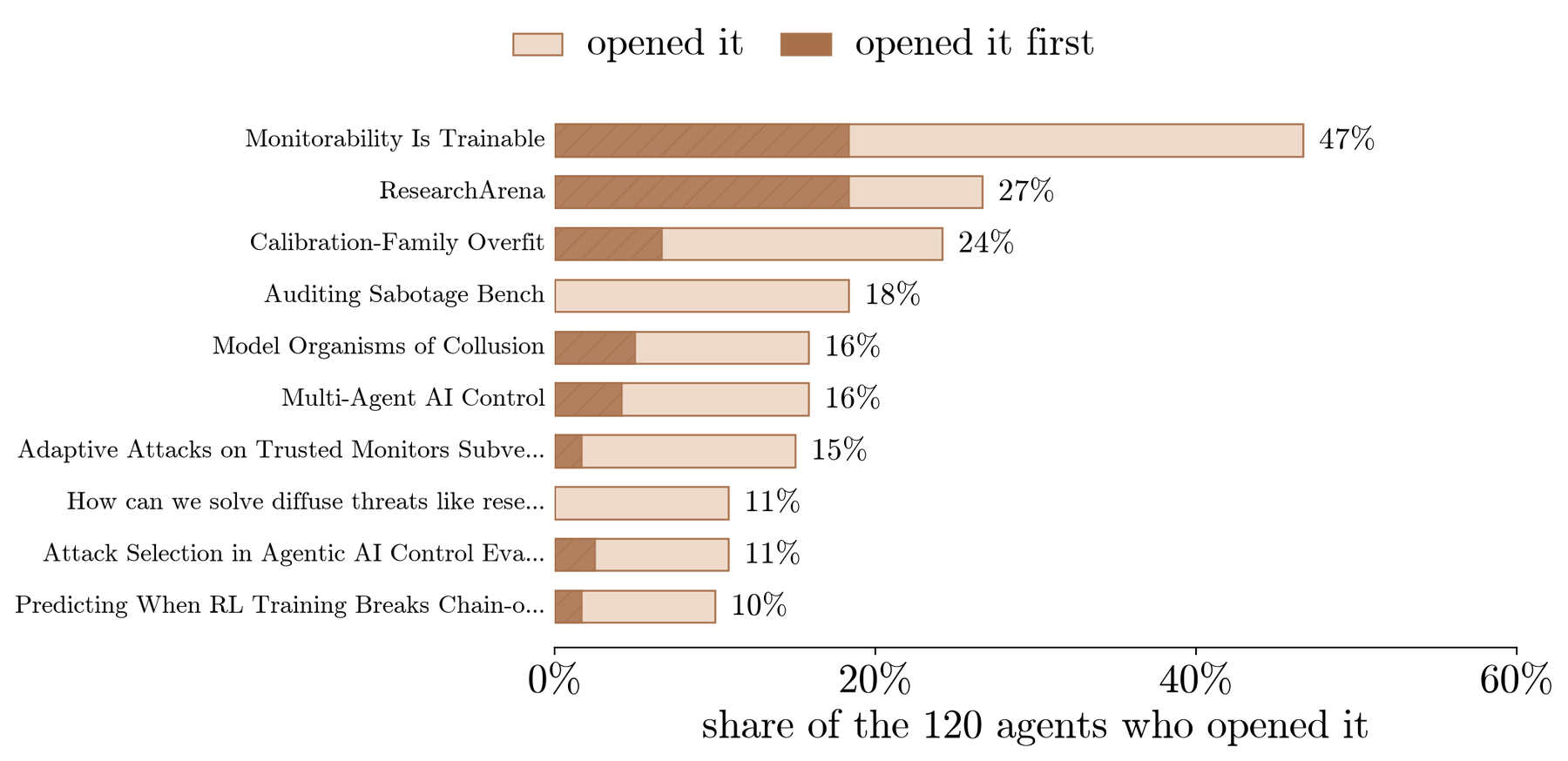
Figure A5. The ten documents the most agents in the frontier setup’s no-tool run opened with the search tool, as a share of the 120 agents. The darker, hatched part of each bar is the agents who opened that document first. Titles are cut at the first colon or after about 40 characters. Counts come from the search tool’s own logs.
Frontier agents searched about ten times and opened about six documents each before choosing, and they went straight to recent papers. Their reading was concentrated. Nearly half opened the same paper on training models to keep their chain of thought monitorable, and four in five opened first a document that another agent also opened first. Across all the documents they opened, agents read about as widely as if they had chosen among 60 equally popular documents. GLM-5.3-flash agents in the simple setup searched twice as often, started from overviews, and read about twice as widely.
Agents who opened the same document first chose the same project about nine times as often as other pairs, but only within a lab’s models. No Claude and GPT pair that shared a first document chose the same project, and opening the most-read paper did not raise the rate. To test whether the reading causes this, we handed 160 frontier agents one paper as the top result of their first search, already opened. Agents handed the most-read paper, on keeping chain of thought monitorable, built on it 60% of the time, against none of those handed a paper on sabotage in automated AI research. Those handed the sabotage paper built on it 95% of the time, against 25% of those handed the chain-of-thought paper. Pairs of one model handed the same paper chose the same project 17% of the time, against 2.5% for pairs handed different papers. Agents almost always ignored an on-topic theory paper outside their usual interests, and an off-topic paper. So what agents read first does steer what they pick, as long as it fits what they were already inclined to do.
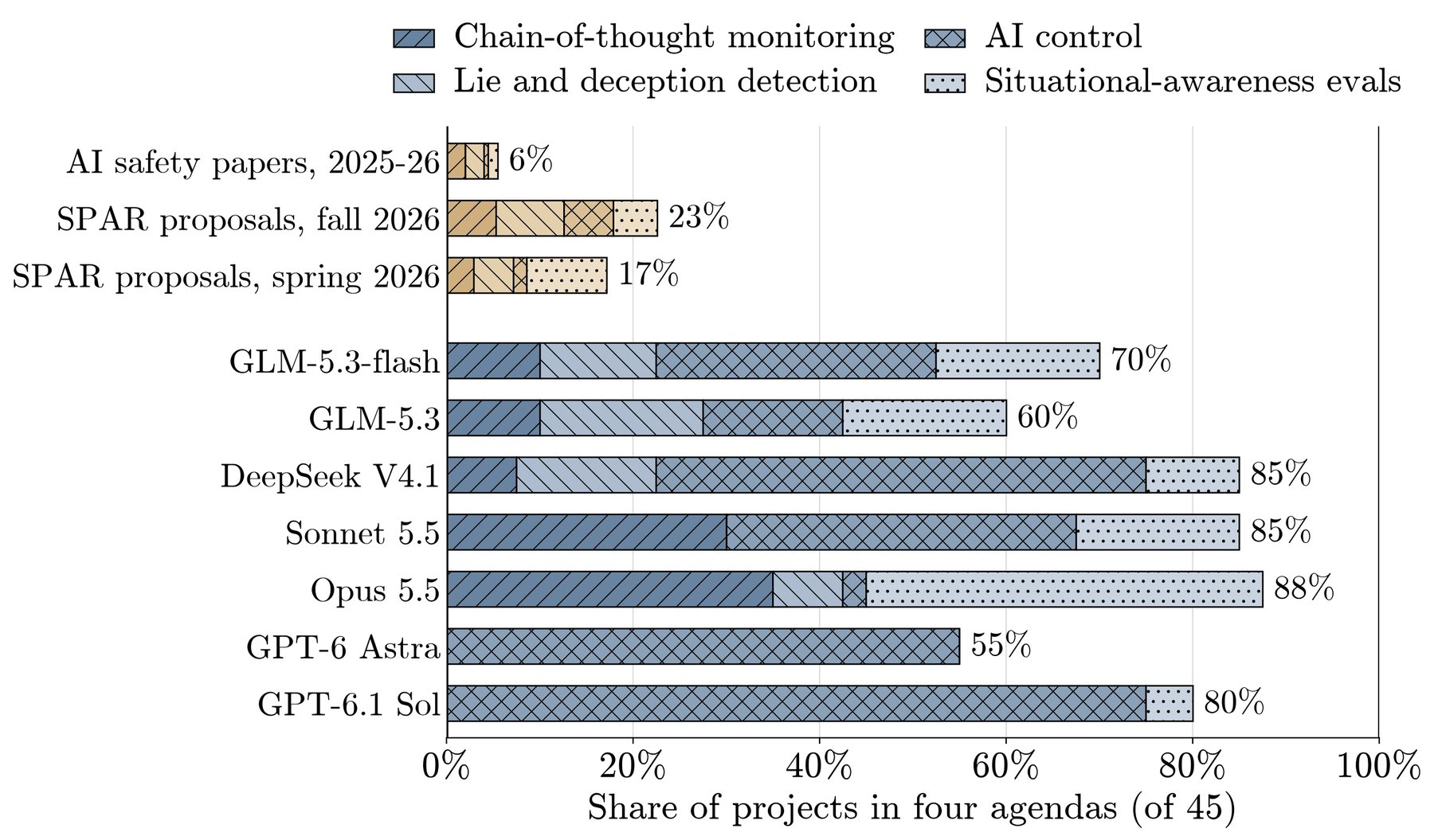
Figure A6. Share of each group’s projects in four of 45 agendas from the 2025 Shallow Review, each marked by its own shade and pattern. Ochre rows are people and slate rows are each model’s group of 40 answering from memory on our brief in the minimal loop, the model rows of Figure A11. The same chart on the earlier, pilot version of the brief, with five models and Sonnet and Opus in Claude Code, is here.
Between about half and nine tenths of each of these seven models’ picks (55% for GPT-6 Astra to 88% for Opus) fall in four agendas: chain-of-thought monitoring, lie detection, AI control and situational-awareness evaluations. The two GPT models put nearly all of theirs in one, AI control (55% and 75%). People work on these too, but they take about a fifth of mentor proposals (17% and 23% in the two rounds) and far less of published papers (6%). The directions are reasonable, but they are the same few.
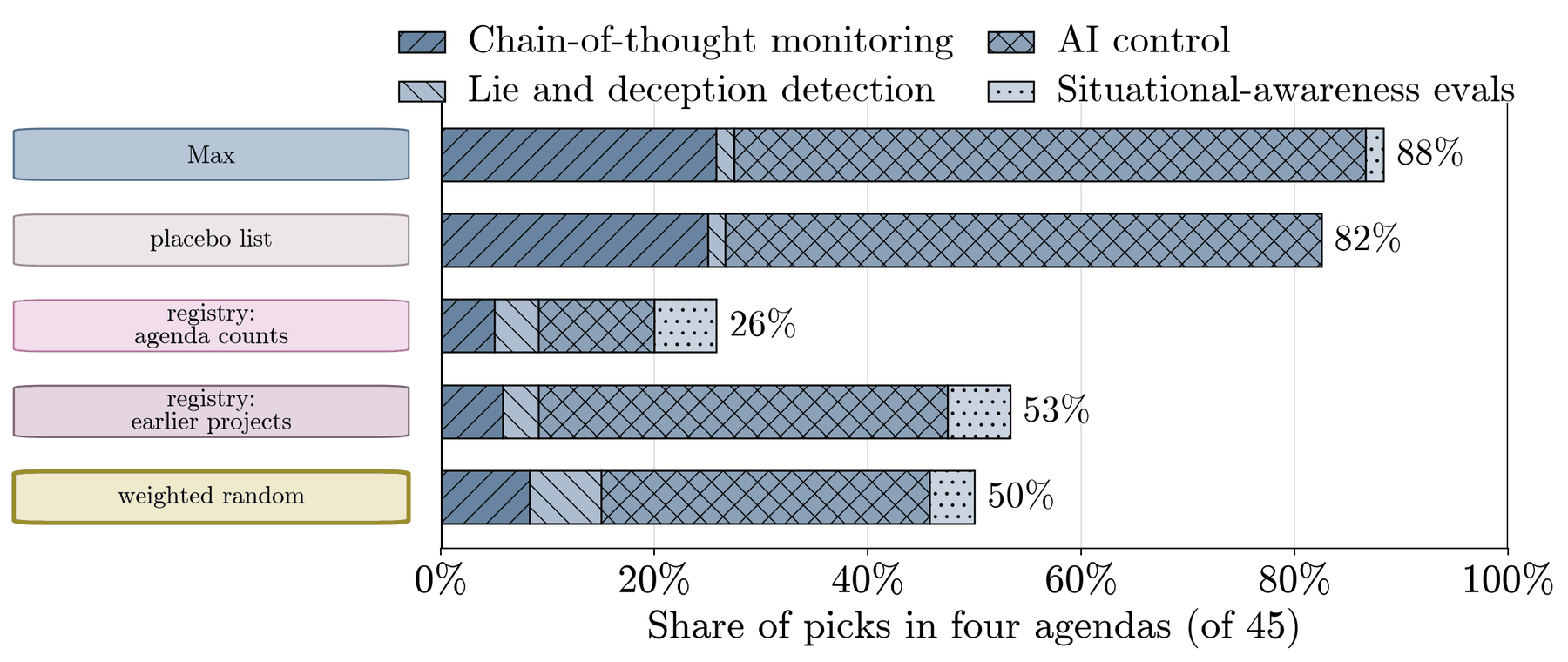
Figure A7. Drawn as Figure A6, for the frontier setup under each rule, every arm on the same 120 combinations of model, launch prompt and harness. Every arm searched. Picks are labelled as in Figure A6, except in the agenda-counts registry, which labelled each pick live as it was made with a different labelling model, so its row is less comparable.
Left alone, 88% of the field’s picks fall in these four agendas, most of them AI control. The placebo list barely changes that. A registry of earlier projects and random draws both cut it to about half, so each spreads agents across problems as well as projects. Judged by its own labels, showing only how many agents work in each agenda moves agents out of the crowded agendas most of all. But they still repeated each other’s projects in the less crowded agendas they moved to, as often as placebo agents in populations of 20 and half as often in populations of 100 (Result 2).
The projects most repeated in the no-tool run, with the number of agents the judge counted as choosing each and the models they ran on, and a random sample of projects chosen with the tree protocol:
| Agents | Models | Project (no added tool) |
|---|---|---|
| 8 | GPT-6 Astra, Opus, GPT-6.1 Sol, Sonnet | Compaction as a Covert Channel: Can Scheming Agents Smuggle Side Tasks Past Their Own Context Resets and Their Monitors? |
| 7 | GPT-6 Astra, GPT-6.1 Sol, Sonnet | Safe Until Calibrated: Benign-Behavior Poisoning of Agent Oversight |
| 7 | GPT-6 Astra, GPT-6.1 Sol | Blind Before You Review: Independent Verification Against Research Sabotage |
| 5 | GPT-6.1 Sol, Sonnet | Counterfactual Audits for AI Safety Research |
| 5 | GPT-6 Astra, GPT-6.1 Sol | ReplayGuard: Counterfactual Re-Training for Sabotage-Resistant AI Research |
| 4 | GPT-6 Astra, GPT-6.1 Sol | When Safety Monitors Forget |
| Model | Project (random draw) |
|---|---|
| Opus | Honeypot Distinguishability Scaling for Untrusted Monitoring |
| GPT-6.1 Sol | Sabotage Detection per Reviewer-Hour |
| GPT-6.1 Sol | Facts Are Not Permissions |
| Opus | Probe vs. CoT monitor vs. output judge: which training penalty actually removes reward hacking? |
| Opus | When Misfit Lies: Testing Misfit as a Label-Free Predictor of Weak-to-Strong Gain |
| GPT-6 Astra | Show What Was Left Out: Evidence-Coverage Disclosure for Agent Approvals |
Each repeated project is counted directly: the agents the judge matched with that one project, without chaining through other projects.
One sentence asking for the most novel direction (Result 3) moved agents off the field’s two crowded agendas. AI control fell from 59% of picks to 30% and chain-of-thought monitoring from 26% to almost none, and picks moved into situational-awareness and scheming evaluations, corrigibility, model psychology and risks between many agents. But they moved together. These are the projects the most novelty agents repeated, counted as in the tables of Where do agents crowd?:
| Agents | Models | Project (novelty sentence) |
|---|---|---|
| 12 | Sonnet | Stale-World Evals: Does Post-Cutoff Novelty Leak “You Are Deployed” to Language Models? |
| 10 | GPT-6.1 Sol, GPT-6 Astra | Correct Verdict, Too Late |
| 8 | GPT-6.1 Sol, GPT-6 Astra | ExitCost: Measuring and Preventing Agent-Induced Dependence |
| 4 | Opus | Contaminated Auditors: Shared-Disposition Blind Spots in Automated Alignment Auditing |
| 4 | GPT-6 Astra, GPT-6.1 Sol | Identifiability Under Adversarial Research Planning |
| 3 | Opus | Writing Your Own Future: Evaluating Intentional Self-Steering via Model-Authored Training Data |
Each lab’s models crowded onto new projects of their own. The twelve Sonnet agents ran in all four harnesses and still proposed the same test, whether facts from after a model’s training cutoff tell it that it is deployed. The GPT models crowded onto several overlapping projects about oversight that comes too late or gets overloaded.
Several studies find that language-model agents who see what others chose follow them. Agents recommending songs while seeing earlier agents’ picks drove their markets far from what each would choose alone, with early leaders pulling further ahead (Hashemi et al., 2026); agents shown their peers’ answers switch to match them (Cho et al., 2025); and groups of agents that discuss research ideas converge on fewer of them (Chen et al., 2026). A registry shows agents what earlier agents chose, so it could have made them crowd together.
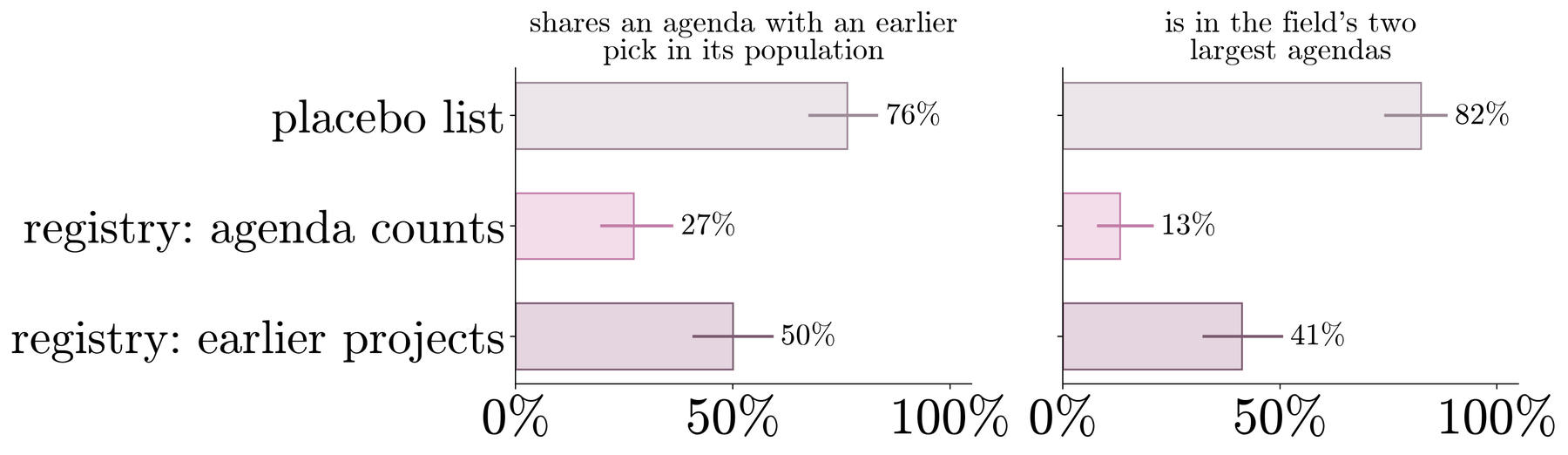
Figure A8. The frontier setup’s registry stage, every pick after the first in its population of 20, coloured as Figure 9. Left, the share of picks in the same agenda as at least one earlier pick in the population; right, the share in the two agendas that dominate the placebo arm, AI control and chain-of-thought monitoring. Bars give the share and lines the 95% interval. Placebo agents saw an unrelated list, so they show what the field does without seeing anyone. The agenda-counts arm was labelled live by a different labelling model.
The agents did the opposite of copying. Placebo agents land in an agenda an earlier agent already took 76% of the time, simply because the field is concentrated. Agents who saw the earlier projects did so 50% of the time, and agents who saw only how many worked in each agenda 27% on its own labels (40% by our hand labels, level with the registry). Seeing the counts moved agents out of the two crowded agendas almost entirely, from 82% to 13% of picks. On a measure that uses no labels, registry picks were also less similar to the nearest earlier pick than placebo picks were, in a text-embedding model’s space (0.49 against 0.60 for agents 10 to 19).
Our best guess at the difference, which we have not tested, is framing. The music study showed popularity to listeners choosing what to enjoy, where following others makes sense. Our registry showed researchers what others were already working on, where doing something else makes sense. But avoiding a crowded agenda did not prevent repeats. Agents shown agenda counts left the crowded agendas yet repeated each other’s projects as often as placebo agents in populations of 20 (Result 2), though only half as often in populations of 100, so they may all have moved to the same few less crowded agendas, as agents in a congestion game did when they all read the same crowding signal (Mori and Johnson, 2026).
The novelty arm and the best-option arm of Figure 12 ran on 17 November, a day after the no-tool arm and the tree. The novelty sentence did raise the effective number of agendas about two and a half to three times. It did so by moving many agents into the same few new topics, and the project measure counts those as new duplicates.
The tree’s projects are written about a quarter shorter than other agents’, which makes our judge find more duplicates among them, so if anything the tree’s number is too low.
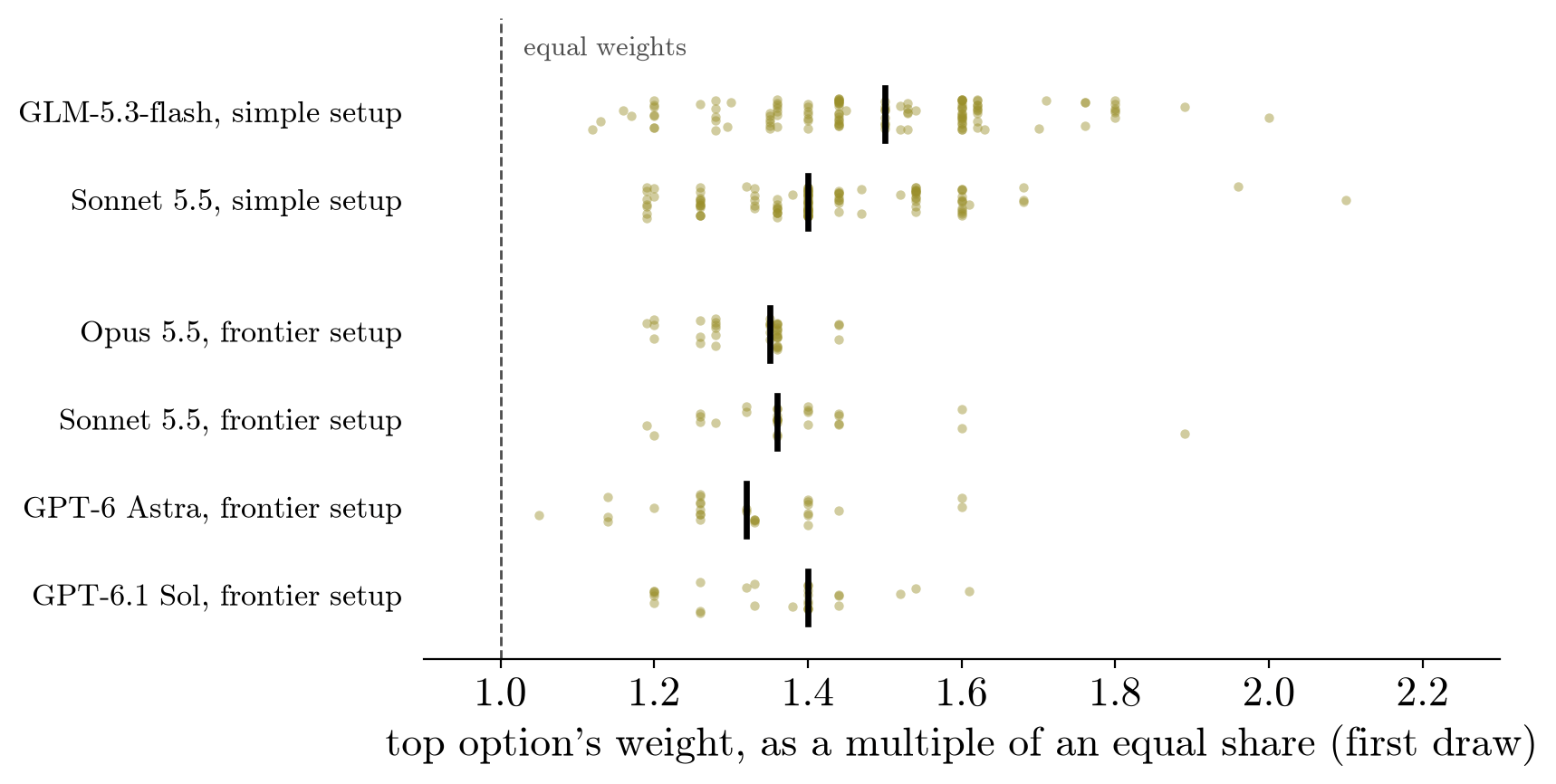
Figure A9. Each dot is one agent’s first draw: the weight it gave its top option, divided by the weight every option would get if all were equal (1 means all equal; with seven options, 7 would mean all weight on one). The black line is each row’s median. The top two rows are the simple setup, answering from memory; the bottom four are the frontier setup’s tree arm, by model.
Every model weights its options nearly evenly: the top option gets about 1.3 to 1.5 times an equal share, and no agent gives it more than about twice. The frontier models in their harnesses are no sharper than GLM-5.3-flash from memory. So in this study the protocol spread agents by drawing almost evenly among each agent’s own options. Weighting by promise, as in Figure 3, played little part.
That may change as models improve, and the evidence on which way is mixed. Outputs of newer models have grown more alike across model families over three years of releases (Patel et al., 2026), though that study tracks release date and not capability, and another found distances between models growing on most measures (Qiu et al., 2026). More capable models copied others less when shown their choices (Hashemi et al., 2026), and non-reasoning models converged on more similar hypotheses than reasoning models in one comparison (Bao et al., 2026). In our own data the most capable models were not the most spread: from memory, the GPT models behaved like 4 to 9 projects and the open models like 7 to 32 (Figure A11). If future models do judge promise more sharply, the tree will concentrate their draws on the projects they rate highest. Agents would then spread less than here, but in proportion to that judgement, as the protocol intends.
Before testing on the frontier setup of the main post, we explored each variable on a simple, cheap setup: one open model, GLM-5.3-flash, answering our brief from memory in our own minimal agent loop, where single changes cost little to test. Every agent got exactly these two messages, and every variant below builds on them. Our first experiment ran in this setup, 120 GLM-5.3-flash agents per condition, and we call it step one.
System: You are an autonomous AI research agent. Today is 2026-11-08.
User: Your job is to find the most promising research direction in AI safety for you to pursue next. Take as much time as you need before you commit.
When you have decided, end your final message with:
DIRECTION: one sentence
PROJECT: title
QUESTION: the research question
FIRST EXPERIMENT: what you will run first
WHY THIS: why it is the most promising, and why it has not already been done
Three grids hold every simple-setup result: one for model, instructions and harness, one for what agents read before choosing, and one for the interventions. Each opens with its setup, drawn as Figure 1. The first two count pairs with screened judging, which misses some duplicates, so they read higher than the every-pair numbers of the main post; the third gives both where both were run. The simple setup shows the same pattern as the frontier setup from a lower start. Judged on every pair, 120 agents taking what they judge best behave like about 13 projects, a registry of earlier projects left 2 duplicate pairs among 19,800, and random draws spread the agents to about 380 (Figure A15). Randomness in sampling changes how an agent reasons and writes, but rarely which project it chooses.
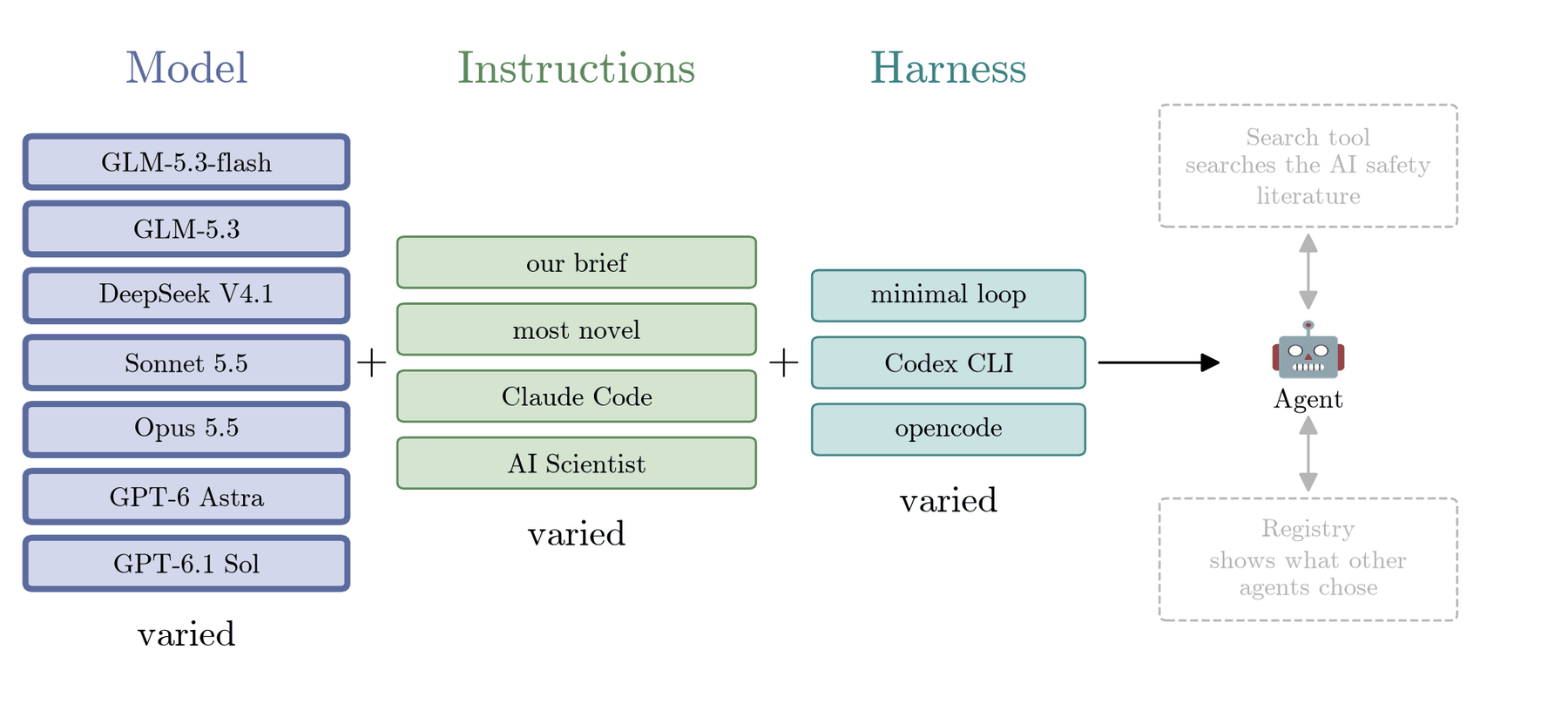
Figure A10. The setup for Figure A11, drawn as Figure 1. Each part varies over these options, one part at a time from the simple setup, and in the last row of Figure A11 every agent drew all three at random.
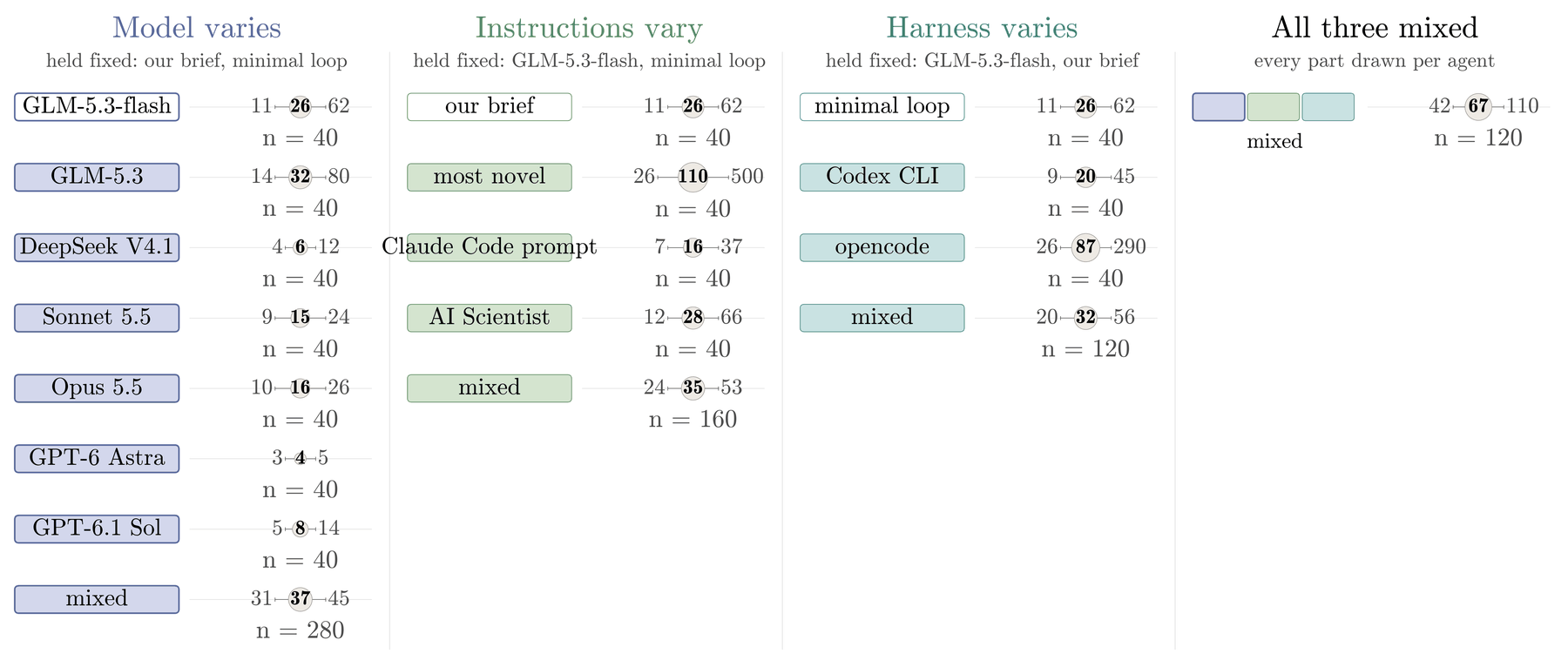
Figure A11. Each panel changes one part of the agent and holds the other two at GLM-5.3-flash, our brief and the minimal loop, as written under each title, so the first row of each of the first three panels is the same starting group, drawn unshaded. Shaded boxes are settings that differ from it. Each circle is an effective number of projects, with the ends of its 95% interval either side and below, with 40 agents per setting. The last row of each panel, “mixed”, pools that panel’s settings, as if each lab used a different one. The right panel is a separate group of 120 in which every agent drew all three parts at random. Model boxes are bold because every model samples its answer. The baseline uses the first 40 of step one’s 120 agents, which read 26 where all 120 read 21. Every pair of agents is counted, with screening, and intervals are 95%, from resampling agents.
Every model behaves like 32 projects or fewer, from 4 for GPT-6 Astra, 7 for DeepSeek and 9 for GPT-6.1 Sol to 15 and 16 for the Claude models and 26 and 32 for the two GLM models. Using different models does make agents choose differently. Two agents of different models choose the same project about a seventh as often as two agents of one model. Even so, all seven models pooled behave like only about 37 projects.
On this brief, the harness makes no difference to which project agents choose. Two agents in different harnesses choose the same project as often as two in the same one. For instructions the evidence is mixed: pooled, different instructions do not clearly separate agents, but where every agent drew its whole setup at random, agents sharing an instruction duplicated each other 2.5 times as often. A one-line Claude Code launch prompt (“Run research on AI safety”, as AutoResearchClaw starts its runs), AI Scientist’s prompt and Codex CLI leave GLM-5.3-flash between 16 and 28 projects, against 26 for the baseline. opencode gives 87, but its interval runs from 26 to 291, and on the pilot brief two identical opencode groups read 29 and 9.
The sentence asking for the most novel direction reads:
Choose the most novel direction you can find, one that few other researchers would pick.
It took GLM-5.3-flash from 26 projects to about 110 on this brief, and from 7 to 60 on the pilot brief. The intervals overlap on this brief but not on the pilot one. The sentence is the same for every agent, so it adds no randomness. Our guess is that it pushes agents away from the most obvious project, so that randomness in their sampling carries them further apart. It did nothing for the GPT models (Figure A16). In the frontier setup, with search, launch prompts and harnesses, the same sentence did not spread projects (Part 3).
Changing all three parts at once, with every agent drawing its model, instructions and harness, gives about 67 projects (42 to 110). Every pool is about two and a half to three times its value on the pilot brief, mostly because each group on this brief is more spread, not because the changes add more variety. That is about where the hackathon whose teams all audited the same models sits (48), and far below people choosing freely.
The level depends on the setup. Our pilot setup, whose brief had one more sentence about the computing resources available, gave this model 7 projects (4 to 13). Moving to this setup raised most models’ levels, Opus’s by about 5 times, from 3 to 16, and lowered two. The sentence is the likeliest cause, but we have not separated it, so we compare numbers only within one setup.
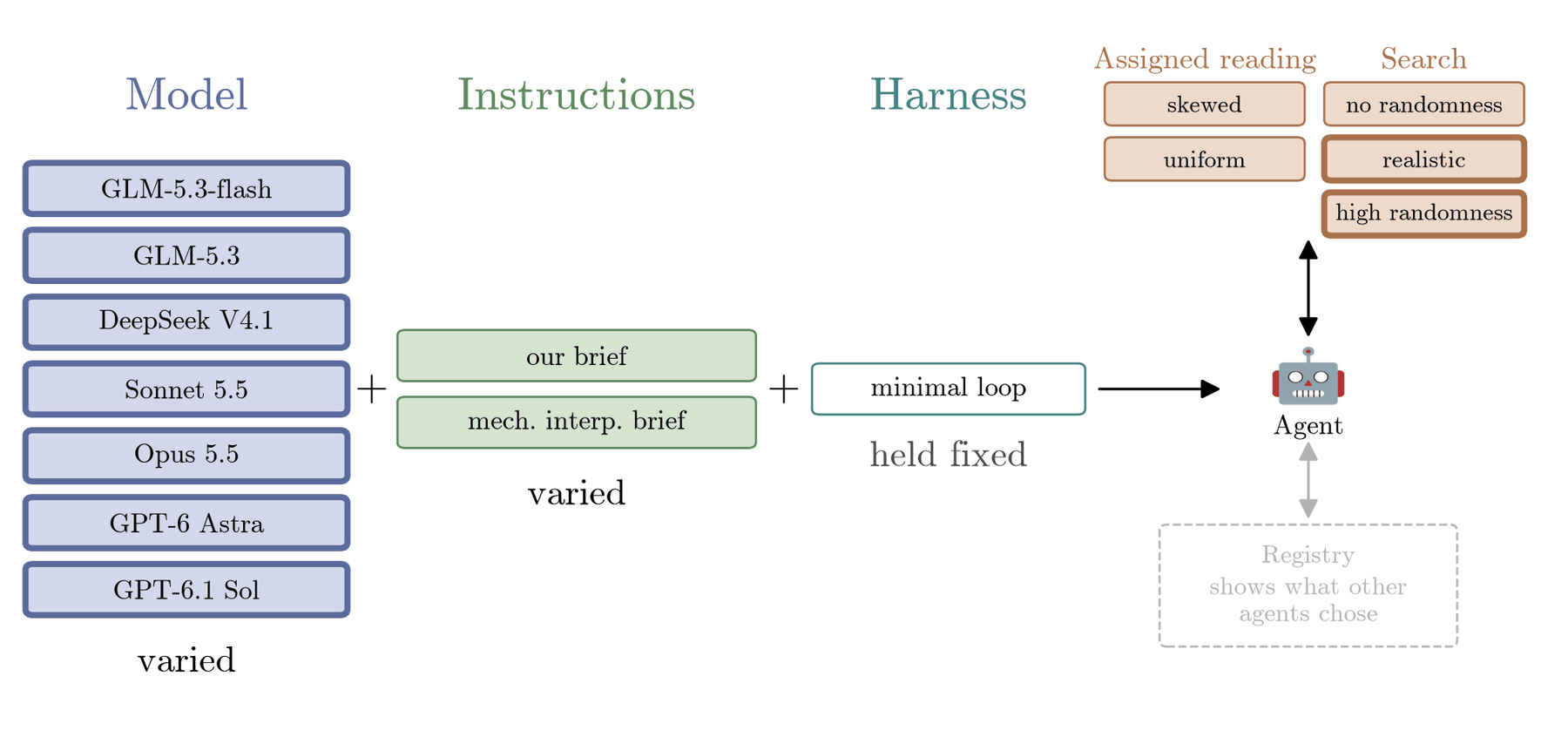
Figure A12. The setup for Figure A13, drawn as Figure 1: seven models, with our brief or with the brief narrowed to mechanistic interpretability, in our loop. Agents read nothing, an assigned list of 88 papers and posts shared by a group, skewed or uniform across topics, or search with no, moderate or high randomness in its results. Search with random results is a source of randomness, so those boxes are bold.
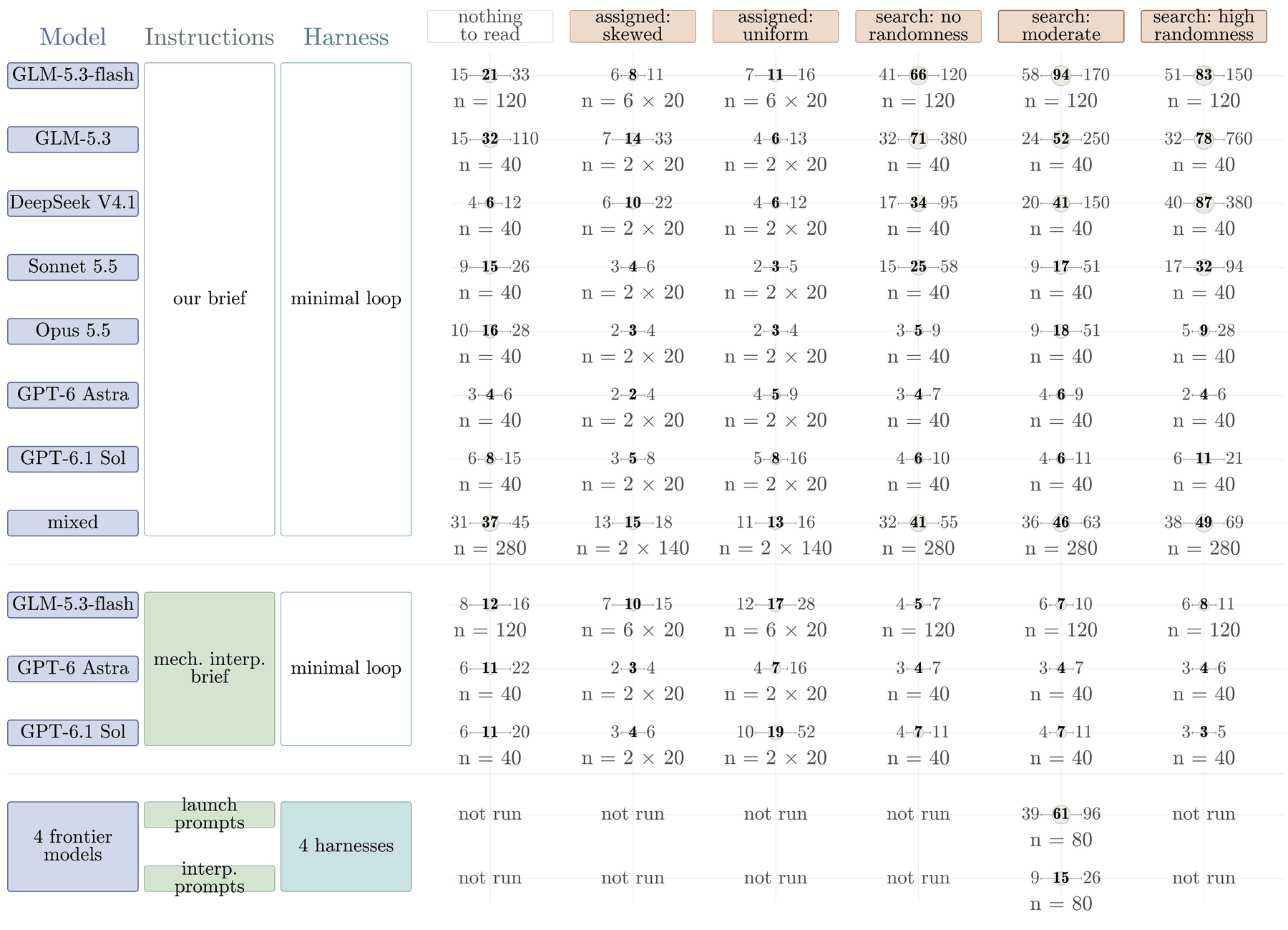
Figure A13. One row per model and brief, one column per reading condition, each circle an effective number of projects with the ends of its 95% interval either side and below. Every pair of agents that shared a setting is counted, with screening. In an assigned-reading column, agents in different groups read different lists, so only pairs that read the same list count, and is written as lists agents per list. Agent number got the same reading, or the same search seed, as agent in the other rows. Each model has 40 agents per cell, except GLM-5.3-flash, whose rows are step one, our first experiment, in groups of 20. Its two search cells without and with high randomness ran twelve groups for a separate test, and the figure shows their first six (with all twelve, both read about 95). The mixed row pools the seven models. The second section narrows the brief to mechanistic interpretability. The bottom two rows are earlier groups of 80 from the frontier setup, with our brief and with the interpretability brief, which ran only with search. Step one’s original analysis, which counts pairs only within each group, gives the same picture with wider intervals.
For GLM-5.3-flash, the top row, search spreads agents two to several times over answering from memory, from 21 to between 66 and 94. A shared reading list may narrow them: it does under our default counting, but not once the judge’s missed duplicates are added back. How much randomness the search results carry makes no clear difference: the three search intervals overlap, and with every agent we ran, no randomness and high randomness both read about 95. Every agent writes its own queries, so agents read different things even when the engine is deterministic, and our guess is that this alone explains the spread. Our test of whether more randomness spreads agents across agendas also found nothing ().
Search splits the models in two. The other open models gain too, but the frontier models barely move: the GPT models stay at about 11 or below and the Claude models range from about 5 to 33 with no consistent gain. In the frontier setup, with launch prompts and harnesses, search did spread the same models’ projects about twice (Figure 6). Our reading, which we have partly tested, is that frontier agents arrive with a topic to look up, and the first strong paper they find on it sets the project. Searching, the GPT models mostly leave their usual project from memory for one built on a single paper that most of them open. When we removed the two texts that most Claude Sonnet 5.5 agents in Claude Code read on chain-of-thought monitoring, they did not leave the topic: 31 of 40 stayed on it, against 34 of 40 in a control run the same day with the texts in place. They opened the next paper on it, built on that one instead, and chose the same projects more often than the control agents, not less.
An assigned reading narrows most models, and it narrows the mix most. Mixing models helps when they read nothing, because two agents of different models rarely choose the same project. A list shared by the group gives every model the same push and erases most of that advantage, so the mix falls from 37 projects from memory to 15 and 13. With search the mix reaches 41 to 49, no higher than the open models searching alone, likely because the GPT models and Opus add many duplicates.
With the interpretability brief, search did the opposite of what it did across the field. Whether it narrows agents at all depends on how strictly duplicates are counted, but the cause is clear, and we tested it. Most searchers type the same first query, which returns one blog post near the top that names a single top open problem. 91% of searchers open it and 73% of those choose that problem. To test whether the post causes the narrowing, we removed it, and a second page that drew the same agents, from our copy of the literature, and re-ran 60 of the searching agents with the same seeds. Their effective number rose about five times, from about 6 projects to 28, back to about where they were from memory, and a measure that uses no judge agrees. No other page took the post’s place. Web search may rank that post lower than our tool does. The GPT models were narrow under every reading with this brief too, and an assigned reading did not spread them. The frontier setup’s earlier groups behave like about 60 projects with our brief, below GLM-5.3-flash searching alone, and about 15 with the interpretability brief, with more than half working on validating interpretability methods. The same field judged on every pair, with 120 agents, gives about 63 (Figure 6).
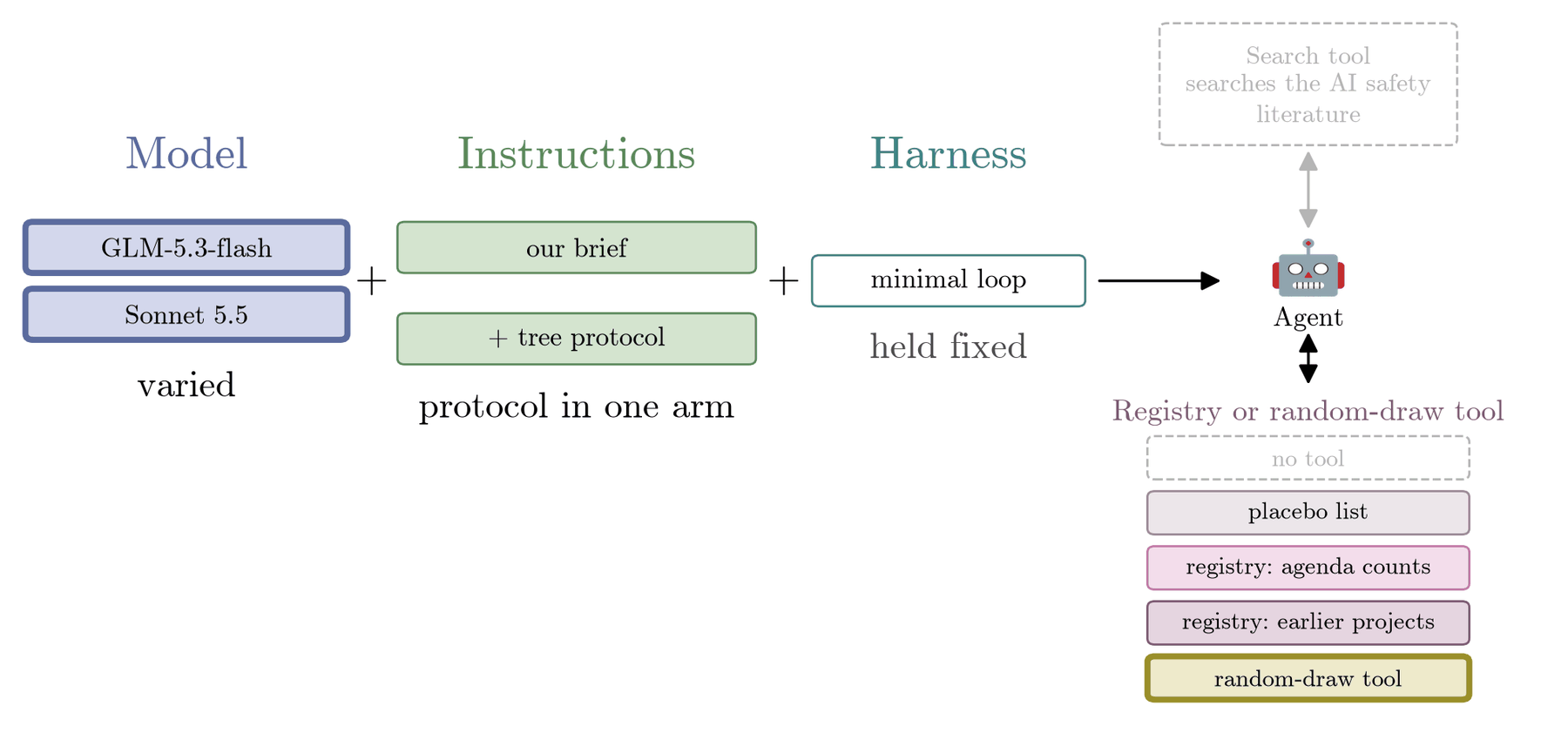
Figure A14. The setup for Figure A15, drawn as Figure 1: the simple setup with no registry or one of three, or with the tree protocol and the random-draw tool. Claude Sonnet 5.5 repeated only the tree test. The random-draw tool is bold because it contains randomness; the protocol’s text does not.
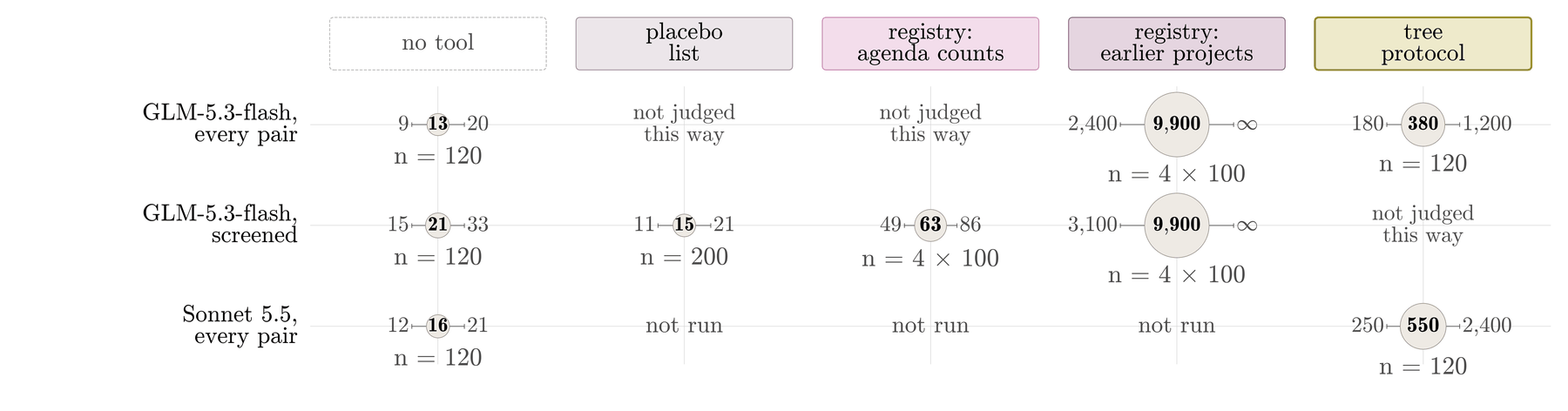
Figure A15. One column per intervention and one row per model and judging rule, each circle an effective number of projects with the ends of its 95% interval either side and below. Every pair means the judge read all pairs; screened means pairs far apart by a small embedding model were counted as different without asking it, the rule we used for the registry’s first stage. Registry agents chose in four populations of 100, so only pairs within a population count; placebo agents chose independently, 200 in all; the other cells are groups of 120. “Not judged this way” marks a cell judged only under the other rule, and “not run” an arm that model did not run.
This was the registry’s first stage. Its curves over 100 agents look like Figure 8’s. A registry of earlier projects left 2 duplicate pairs among 19,800, so few duplicates that neither judging rule can put an upper limit on the number. Agenda counts cut the share of duplicate pairs by about three quarters, much less than listing the projects themselves. All 1,000 agents checked the registry before choosing.
With the protocol, the 120 GLM-5.3-flash agents behave as if they had about 380 projects to choose from, against 13 without it. Judging all 299 agents we ran with the protocol gave about 480 (300 to 850), so the first 120 were typical. A repeat of the simple setup with Claude Sonnet 5.5 in place of GLM-5.3-flash spread just as far, from about 16 projects to about 550. Two checks that use no duplicate judge agree in direction: the protocol tripled the number of agendas agents spread over, and moved picks apart in a small text-embedding model’s space.
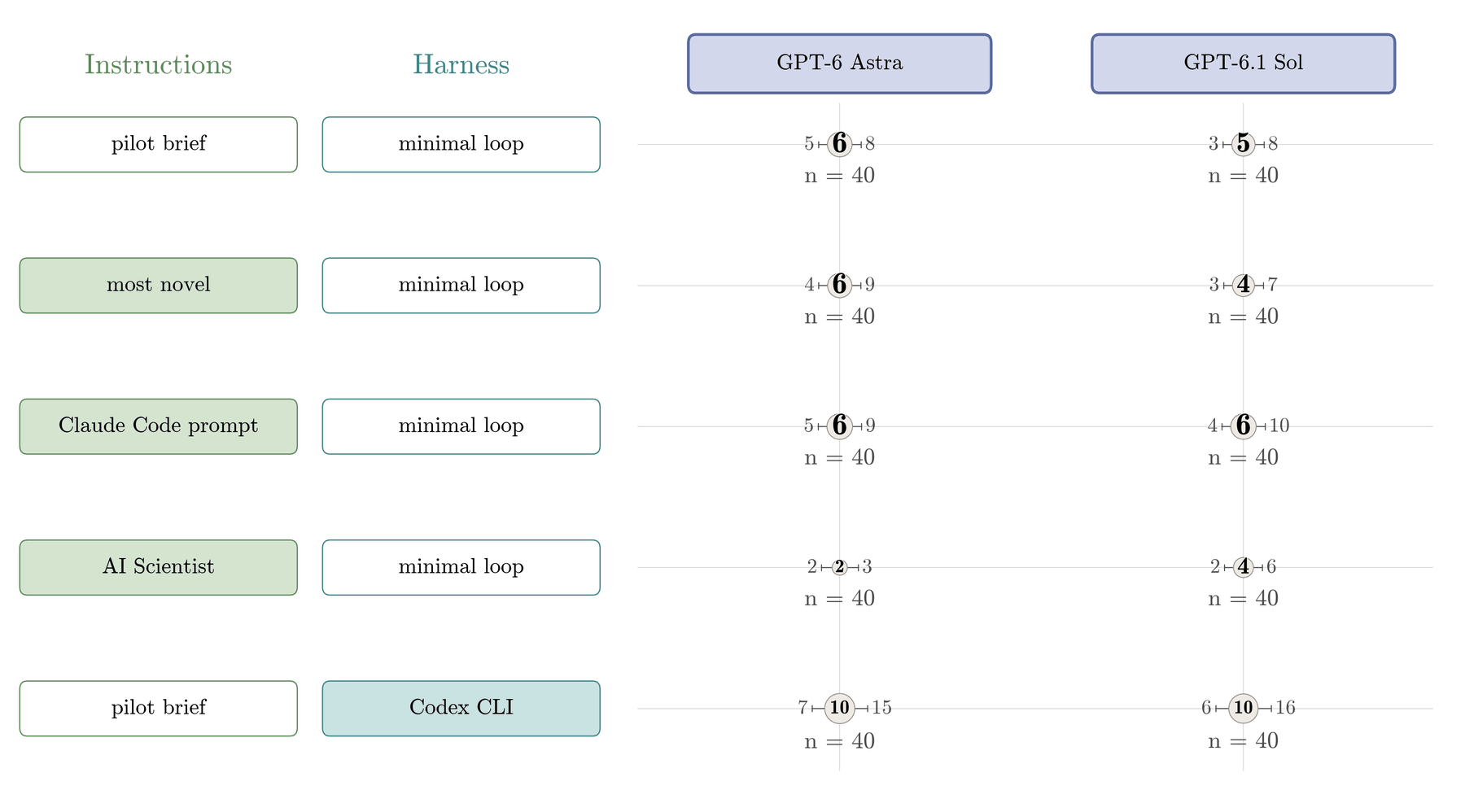
Figure A16. The two GPT models on the pilot version of the brief, one column per model and one row per setting: four instructions in the minimal loop, and our brief in Codex CLI. A shaded box is the setting that differs from our brief in the minimal loop. Each circle is an effective number of projects, with the ends of its 95% interval either side and below, with 40 agents per cell. The model headings are bold because every model samples its answer.
The novelty sentence did nothing for the GPT models, and AI Scientist’s prompt narrowed them, because most GPT agents already propose one theme, how an agent’s stored memory can make untrusted claims look trusted, and that prompt pushes them further toward it. Codex CLI roughly doubled their spread.
Everything behind the numbers in this post is in the public repository github.com/AverroesLabs/ai-research-agent-diversity.
data/
holds one set of files per experiment: each agent’s model, harness,
launch prompt and answer, every pair of agents the judge read with its
verdict in both orders (for a few experiments only the duplicate pairs
survive, as DATA.md
explains), agenda labels, the tree protocol’s draws and what searching
agents read. People’s groups are released as item ids and links, without
their texts. data/experiments.json
lists every experiment with its figures, dates, sample sizes and the
effective numbers we report.DATA.md
gives the schema of every file, how duplicates are defined and judged,
and what is released as ids only.analysis/
is a small Python package (numpy only) that computes the effective
number of projects and its bootstrap interval.
python3 analysis/reproduce.py recomputes every effective
number in experiments.json from the released files and
prints it beside the reported value.transcripts/
holds the full sessions of 8,153 of the 9,038 agents, with search
results, opened documents and reading lists reduced to document ids and
links, and adapted launch prompts to their ids. data/corpus_docs.jsonl
lists all 99,464 documents in the literature corpus the search tool
used, and data/judge_checks/
holds the blind labels behind the judge appendix.paper/
holds this text as a PDF, a web page and Markdown, with its LaTeX
source.prompts/
gives every prompt we used, EXPERIMENTS.md
describes how each experiment ran, and replicate/
holds reference code for the agent loop, the search, registry and
random-draw tools, the judge and the labeller, and a driver that runs
any frontier condition over its slots. EXPERIMENTS.md ends with a
checklist of what a rerun can and cannot reproduce.In all, the study spent about $1,260 through OpenRouter and $620 through OpenAI’s API (as of 18 November 2026), including pilots and checks the post does not report.
Data and text are licensed CC BY 4.0, and code MIT (see LICENSE).
The robot icon in the setup diagrams is the robot emoji from Google’s Noto Emoji (Apache License 2.0).
Jason Fantl. Many Agents, Few Projects: Measuring and Reducing Convergence in AI Research Agents’ Choice of Safety Research. Averroes Labs, November 2026. https://averroeslabs.org/blog/many-agents-few-projects/
@misc{fantl2026manyagents,
  title  = {Many Agents, Few Projects: Measuring and Reducing Convergence in AI Research Agents' Choice of Safety Research},
  author = {Fantl, Jason},
  year   = {2026},
  month  = nov,
  publisher = {Averroes Labs},
  url    = {https://averroeslabs.org/blog/many-agents-few-projects/},
  note   = {Data and code: https://github.com/AverroesLabs/ai-research-agent-diversity}
}